Winners in Life

“One of our family’s all-time favorite pets was a dog named Scampy. He was a black-and-tan, rag-eared mutt, part cocker, part Schnauzer, part whatcha-ma-call-it. When he was six months old, he was hit by a car and suffered a broken hind leg, which was put in a splint. Gangrene developed, and the veterinarian recommended euthanasia. My children, however, full of love and affection for Scampy, lobbied for amputation, and their tearful motion, put to a vote in a family council, was carried.

To my pleasant surprise, Scampy adjusted beautifully. Like a tricycle with the wheels reversed, he developed excellent balance, and although running in unorthodox motion, he moved amazingly fast. Squirrels scattered when he flew off the back porch as though propelled by a pogo stick.

Friends of the children called him Hopalong or Tripod or Crip, among other names, but Scampy had a couple of advantages over people: He didn’t understand their jibes, and he didn’t know that he had a disability. He lived on courageously for many years, doing the best with what he had. People who can do the same are, I am convinced, the winners in life.”

Fred Bauer “Dog Tales – Lessons in Love” from Guideposts

Get "Go for the Gold" Youth Bible Study SeriesGo for the Gold
Need an evangelistic Youth Camp/ Bible Study Series with an Olympic Theme?

What is salvation all about? What does it mean to be saved? This sports themed Bible Study / Camp Curriculum uses the Olympic Flag to introduce the concepts of sin (black circle), forgiveness (red circle), purity (white background), spiritual growth (green circle), heaven (Yellow Circle) and (Baptism) blue circle.
-> Tell me about “Go for the Gold”

Get "Destined to Win" Youth Bible Study SeriesDestined to Win
Need a Youth Camp/ Bible Study Series on “Running the Christian Race”?

The race as a metaphor for the Christian life is used in several places in the Bible. This series is a great follow up for new Christians or to re-emphasize the basics of our spiritual Journey in the Faith. This Bible Study / Camp Curriculum has a sports theme and is great for athletes as well as a tie in to the youth Olympic Games.
->Tell me about “Destined to Win”

Dog Tales – Lessons in Love

“Ashley–a pre-owned Yorkie from the Humane Society–came into my home with his head hung low. The neighbors were all waiting for me at home to meet the newest member of my family. That was when we learned that this little dog was terrified of men.

In their presence, Ashley would shake like a leaf. All my men friends are gentle, but their imposing sizes and booming voices seemed to terrorize him. I had to find a way for Ashley to be healed of his fear!

Whenever a male visitor came to the door, I would pick up Ashley and hold him in my arms. I would ask my friend to pet the dog gently and talk to him in a soothing voice. When the little guy relaxed, I would hand him over to my friend to hold and continue petting for a few more minutes.

After some weeks, Ashley seemed to remember each man he met in this way, and he stopped cowering and shaking in their presence. In fact, after meeting my next door neighbor, Bob, Ashley stole into his house, then reappeared a few minutes later to drop one of Bob’s dirty socks at his feet. Bob, he seemed to be saying, was not only safe, he was accepted!

Since coming into my family, Ashley has been healed of his fear and to this day lives at peace with all men. It’s the love he’s been getting that’s healed his fear–I’m sure of it.

And not only is Ashley a beloved family member now, but he also reminds me how to approach all the abused and fearful people I meet. The best way is to start with love.

Diane Komp – “Dog Tales Lessons in Love” from Guideposts Magazine


MORE IDEAS? See “Creative Object Lessons”

200 page e-book that explains everything you need to know when planning your very own object lessons. It contains 90 fully developed object lesson ideas and another 200 object lesson starter ideas based on Biblical idioms and Names / Descriptions of God.

Learn More…

Little Tasks

Always keep your eyes open for the little task, because it is the little task that is important to Jesus Christ. The future of the Kingdom of God does not depend on the enthusiasm of this or that powerful person; those great ones are necessary, too, but it is equally necessary to have a great number of little people who will do a little thing in the service of Christ.

The great flowing rivers represent only a small part of all the water that is necessary to nourish and sustain the earth. Besides the flowing river there is the water in the earth–the subterranean water–and there are the little streams which continually enter the river and feed it and prevent it from sinking into the earth. Without these other waters–the silent hidden subterranean waters and the trickling streams–the great river could no longer flow. Thus it is with the little tasks to be fulfilled by us all.”

Albert Schweitzer


Get "Creative Sermon Ideas" eBook

Get Help on Your Youth Sermons

Creative Sermon Ideas
This 100 Page e-Book Includes All The Help You Need To Prepare Powerful, Life-Changing Youth Sermons That Will Turn Your Preaching Around And Make Your Youth Sit Up And Listen! Includes 7 Complete Sermons.
–> I want More Youth Sermon Ideas…

Asking the Right Questions

Jesus was the Master Teacher. Not only was He an excellent communicator, but he also had the ability to ask questions that probed both the heart and the mind. The disciples were challenged to answer His questions with more than superficial, fact-based answers. The questions Jesus asked caused listeners to think and evaluate before responding.

Asking good questions is both an art and a skill. Teachers today can learn to ask questions that cause people to reflect and evaluate as well as give fact-based answers. Here’s some guidelines to improve your questions.

  • Ask open-ended questions – Questions should be asked in such a way that students will be able to provide a variety of responses. For example, if you have a lesson on the vine and the branches. Don’t ask the obvious question – What does Jesus compare us to? Your only answer is “A vine” Instead ask, “What are some of the possible reasons Jesus used a vine to represent us as Christians?”
  • Ask one question at a time. Focus everyone’s thoughts on a single question and you will get much better answers and lively discussion.
  • Address everyone with the questions. Don’t allow one person to answer all the questions. Spread them around, call students by name, invite more people to answer. Some of your most quiet kids might have some of the deepest insights.
  • Provide positive feedback based on member responses. When you tell a student he is wrong, you will quickly have a silent room when you try discussions in the future. Affirm everyone for giving an answer, then artfully ask questions and pose alternative to guide students to the correct answers.
  • Follow some questions with another question. The purpose is to generate discussion, not to test a student’s knowledge. Students need to be engaged in conversation.
  • After asking questions, wait for a response. If no response comes quickly, ask the question again and tell learners you will wait for them to think about their answers. People need time to think. Silence may seem uncomfortable but don’t rush too quickly to end the silence.
  • Challenge people to answer their own questions sometimes. Occasionally a question can best be answered by the questioner because that person really does know the answer. They just need a little help to think through it and sift it out from their thoughts.
  • Affirm all responses. Even incorrect answers reflect an effort to learn. When necessary, comment on incorrect ideas or answers, but be careful not to discourage people from answering questions in the future.
  • Admit you don’t have all the answers. When necessary, promise to provide answers to questions you cannot answer in the session. Follow up individually or with the entire class to make sure correct answers are given.


Get "Creative Sermon Ideas" eBook

Get Help on Your Youth Sermons

Creative Sermon Ideas
This 100 Page e-Book Includes All The Help You Need To Prepare Powerful, Life-Changing Youth Sermons That Will Turn Your Preaching Around And Make Your Youth Sit Up And Listen! Includes 7 Complete Sermons.
–> I want More Youth Sermon Ideas…

Deeper Worship

Excerpt from Ronald F. Bridges “Rediscovering Your First Love” (Here’s Life Publishers, Inc.)

A good friend of mine was aggressively pursuing a deeper worship experience with the Lord. His love for God was growing stronger and his desire to draw nearer to Him was sincere. After a couple of months of trying various activities to aid his worship, Rick came to me in frustration, saying that he was unable to feel a genuine sense of worship.

There just seemed to be something lacking, and he couldn’t put his finger on it. He was also finding it difficult to concentrate and felt restless during his quiet times…

All of us, at times, carry within us a certain amount of unresolved conflict that can affect us emotionally but not
necessarily hinder our worship. But in Rick’s case, he had been totally unwilling to forgive his father even after his
father asked his son’s forgiveness. When all of this surfaced, Rick finally realized his sin of unforgiveness toward his father was probably affecting his worship…

After several weeks of prayer and resolution, Rick was able to finally go to his father and tell him that he forgave him, as well as to ask his father’s forgiveness for carrying the grudge. As soon as he did this, not only did he renew a strong relationship with his father, but he also began to experience a deeper intimacy in worship with his heavenly Father.

It’s not surprising that in a growing love relationship with God, the closer we draw to Him, the more accepting we are when He reveals things we need to deal with…

In terms of our worship, there are at least four different kinds of hindrances that not only hinder worship but could also very easily hinder our progress in a love relationship with God.

Unconfessed Sin
…In order to clear our worship, we must cleanse our lives from sin (1 John 1:9), thus restoring our fellowship with God.

Unforgiveness
…unforgiveness must be humbly confessed to God and honestly resolved before our fellow man, in order to allow our worship to be acceptable to the Lord.

A Self-Centered or Prideful Spirit…
From a worldly perspective, it would be very easy to view the worship of God as a ‘what’s in it for me’ experience…we could also enter into worship with feelings of discontentment or impatience. But such negative feelings would indicate that we are not satisfied with God’s design for our lives…

Impurity
…we are not necessarily impure if we experience a sudden reaction to an initial display or suggestion of something impure. The impurity comes in if our second reaction is not to reject the temptation and flee from it…the psalmist provided the solution: ‘How can a young man keep his way pure? By keeping it according to Thy word’ (Psalm 119:9)

The worship of God is an awesome and powerful experience. We must never enter into it with a flippant attitude or an insincere heart. Therefore, our aids to worship must be activities that cause us to focus totally on God…


MORE IDEAS? See “Creative Object Lessons”

200 page e-book that explains everything you need to know when planning your very own object lessons. It contains 90 fully developed object lesson ideas and another 200 object lesson starter ideas based on Biblical idioms and Names / Descriptions of God.

Learn More…

The Color Yellow

starrynight.jpg
Noted artist Vincent Van Gogh turned away from the faith which had been imparted to him in his Christian home and sank into depression and self-destruction. But later in his life by the grace of God, as he began to embrace that faith again, his life took on new hope, and he gave to that hope color, specifically the color yellow, which evoked for him hope and warmth in then truth of God’s love.

In his depression period, seen in his The Starry Night, there is a yellow sun and yellow swirling stars because Van Gogh thought that truth was only present in nature. The church, which stands tall in the painting and should be the house of truth, is the only item with no traces of yellow.

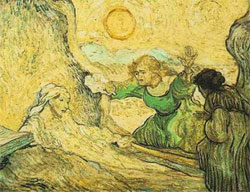
raising_lazarus.jpg
But later, when his life was on the mend, he painted The Raising of Lazarus, and the entire picture is bathed in yellow. He even put his own face on Lazarus to express his hope in the Resurrection.

Yellow tells the whole story. Like Van Gogh, we can start over.

Source: Unknown


MORE IDEAS? See “Creative Object Lessons”

200 page e-book that explains everything you need to know when planning your very own object lessons. It contains 90 fully developed object lesson ideas and another 200 object lesson starter ideas based on Biblical idioms and Names / Descriptions of God.

Learn More…

Heart Rate

Introduction
Use this activity as an introduction to a study on taking care of your heart.
“Above all else, guard your heart, for it is the wellspring of life.” – Proverbs 4:23

Activity

  1. As the youth arrive at the meeting, ask them to calculate their heart rate. (Each youth must find his/her pulse on a wrist and count the number of heartbeats in a 60-second time period.)
  2. Next, instruct youth to walk quickly around the room for about two minutes.
  3. When two minutes have passed, the youth must take their pulse again and compare the difference between the two heart rates.

Discussion

  1. What do you think is a healthy heart rate?
  2. Why is it important to have a healthy heart?
  3. How do you know if a heart is healthy or not?
  4. What are some of the signs that something is wrong with your heart?
  5. How should we respond to heart problems?
  6. What would you do if you had heart problems?
  7. How do you take care of your heart?

Spiritual Lessons

  1. Why is it important for your spiritual heart to be healthy?
  2. How do you know if you have a healthy spiritual heart?
  3. What are some of the characteristics of a healthy spiritual heart?
  4. What are some of the signs that something is wrong?
  5. What are some of the things we can do if we discover something is wrong with our heart spiritually?
  6. How can we take care of our spiritual heart?

Application

  1. How would you rate your spiritual heart rate?
  2. What is something you can start doing today to improve your spiritual heart condition?


MORE IDEAS? See “Creative Object Lessons”

200 page e-book that explains everything you need to know when planning your very own object lessons. It contains 90 fully developed object lesson ideas and another 200 object lesson starter ideas based on Biblical idioms and Names / Descriptions of God.

Learn More…

Daffynitions

Introduction
Next time you have a lesson on a difficult theological concept, distribute a list of words for which kids are unlikely to know the exact definitions:

Examples
atheism, atonement, beatitude, covenant, eschatology, Eucharist, predestination, gnosticism, grace, justification, meek, propitiation, repentance, sanctification, supplication, transfiguration, etc.

Activity

  1. Have each student define the words, one word at time on a small piece of paper. They must write their name, the word, and then the definition. Participants can write phony definitions when they don’t know the real definitions, but the phony ones should sound as realistic as possible to score points.
  2. Collect all the definitions. Also have one prepared for each with the correct definition for comparison.
  3. Read the various definitions out loud.
  4. After you read the definitions, let students vote for what they think is the closest to the real definition-one vote per student.
  5. Add up the votes, reveal the real definition, and then award points as follows:
    • Kids who write correct definitions earn five points for each one.
    • Kids whose phony definitions receive the most votes earn five points per vote.

You can also allow the students to discuss the various definitions and which one is the closes to the true definition and why. Its a great activity to promote discussion.

NOTE
If your group is so large that it is hard to keep track of definitions, create smaller groups.

Variation
Instead of using a definition of a word, do the same thing with Bible teachings. Just ask students to write: “What the Bible teaches about: ” Use any Biblical concept. Play it the same way.


MORE IDEAS? See “Creative Object Lessons”

200 page e-book that explains everything you need to know when planning your very own object lessons. It contains 90 fully developed object lesson ideas and another 200 object lesson starter ideas based on Biblical idioms and Names / Descriptions of God.

Learn More…

Four Wives

There was a rich merchant who had 4 wives. He loved the 4th wife the most and adorned her with rich robes and treated her to delicacies. He took great care of her and gave her nothing but the best.

He also loved the 3rd wife very much. He’s very proud of her and always wanted to show off her to his friends. However, the merchant is always in great fear that she might run away with some other men.

He too, loved his 2nd wife. She is a very considerate person, always patient and in fact is the merchant’s confidante. Whenever the merchant faced some problems, he always turned to his 2nd wife and she would always help him out and tide him through difficult times.

Now, the merchant’s 1st wife is a very loyal partner and has made great contributions in maintaining his wealth and business as well as taking care of the household. However, the merchant did not love the first wife and although she loved him deeply, he hardly took notice of her.

One day, the merchant fell ill. Before long, he knew that he was going to die soon. He thought of his luxurious life and told himself, “Now I have 4 wives with me. But when I die, I’ll be alone. How lonely I’ll be!”

Thus, he asked the 4th wife, “I loved you most, endowed you with the finest clothing and showered great care over you. Now that I’m dying, will you follow me and keep me company?” “No way!” replied the 4th wife and she walked away without another word.

The answer cut like a sharp knife right into the merchant’s heart. The sad merchant then asked the 3rd wife, “I have loved you so much for all my life. Now that I’m dying, will you follow me and keep me company?” “No!” replied the 3rd wife. “Life is so good over here! I’m going to remarry when you die!” The merchant’s heart sank and turned cold.

He then asked the 2nd wife, “I always turned to you for help and you’ve always helped me out. Now I need your help again. When I die, will you follow me and keep me company?” “I’m sorry, I can’t help you out this time!” replied the 2nd wife. “At the very most, I can only send you to your grave.” The answer came like a bolt of thunder and the merchant was devastated.

Then a voice called out : “I’ll leave with you. I’ll follow you no matter where you go.” The merchant looked up and there was his first wife. She was so skinny, almost like she suffered from malnutrition. Greatly grieved, the merchant said, “I should have taken much better care of you while I could have !”

Actually, we all have 4 wives in our lives

a. The 4th wife is our body. No matter how much time and effort we lavish in making it look good, it’ll leave us when we die.

b. Our 3rd wife ? Our possessions, status and wealth. When we die, they all go to others.

c. The 2nd wife is our family and friends. No matter how close they had been there for us when we’re alive, the furthest they can stay by us is up to the grave.

d. The 1st wife is in fact our soul, often neglected in our pursuit of material, wealth and sensual pleasure.

Guess what? It is actually the only thing that follows us wherever we go. Perhaps it’s a good idea to cultivate and strengthen it now rather than to wait until we’re on our deathbed to lament


MORE IDEAS? See “Creative Object Lessons”

200 page e-book that explains everything you need to know when planning your very own object lessons. It contains 90 fully developed object lesson ideas and another 200 object lesson starter ideas based on Biblical idioms and Names / Descriptions of God.

Learn More…

Who’s your Ninevah?

Jonah is one of my favorite Bible characters.

Out of his comfort Zone
Jonah was faithfully serving God, living among his own people and sharing God’s words for them. Then God suddenly asks him to do something that was a little outside the norm.

In the Old Testament, Israel witnessed to the world by serving God and living for Him, setting themselves apart for Him. They did not go to the world, but instead the world, enticed by their faith and prosperity, came to them. When God asked Jonah to go to Ninevah, that was simply “not the way things were done”.

Instead of proclaiming the words of God to his own people, as most prophets were called to do, Jonah was to go to a new place, Ninevah, and tell them about God. At the time of Jonah, Ninevah was a large Gentile city, about 60 miles in circumference with a population of about 600,000 people.

Hostile Listeners
Ninevah was the capital city of
Assyria and was renowned as one of the most cruel and brutal nations in the ancient world. They thought nothing of burying their enemies alive, skinning them alive, or impaling them on
sharp poles under the hot sun until they died of sunburn and exposure.

Unwelcome Message
Furthermore, Jonah’s message was not to be one of “God’s Love”, but of “God’s Judgement.” Its one thing to tell others about God’s love, but to tell of God’s judgement is not a welcome message people want to hear.

Jonah’s Response?
Add it up and we can understand why Jonah would run! Outside his comfort zone, hostile listeners, and an unwelcome message.

Looking at Ourselves
How often our lives are overturned because God asks us to do something that was simply not comfortable, or worse, against the norms. He calls us to deliver his words, but it’s not to someone we want to tell. And sometimes his message is simply not welcome.

Who is your Ninevah?
We can’t be content to live our lives as Christians and hope the world will come to us. The New Testament “Great Commission” was to go into the world and make disciples of ALL nations. Are we willing to get out of our comfort zone to do so?

That’s the story of Jonah. We see his struggle, his failures, and we can understand. We also see God’s grace and compassion in dealing with his children, as well as, his over arching purpose to offer redemption to everyone – even the worst of us. I may not find myself in the belly of a whale, but I know I often do a little “belly-aching” when it comes to obedience in my own life. I have also seen God go to extraordinary means to get my attention, offer me his grace, and lovingly encourage my obedience to his call!

The life of Jonah is full of lessons for all of us. To explore these lessons yourself, or with the youth you work with, check out “A Whale of a Tale”, my Bible Study curriculum based on the life of Jonah. It’s great for youth camps or for a Bible study series.

Click here to find out about my youth Camp Curriculum “A Whale of a Tale” on the book of Jonah.