
 While the use of holly is rooted in pagan lore, many Christian legends have developed over the centuries to the point that it is now linked with Christmas. In some parts of Britain holly was formerly referred to merely as Christmas, and in pre-Victorian times ‘Christmas trees’ meant holly bushes. Even so, “Decking the Halls with Boughs of Holly” is an ancient custom several thousand years old. In fact, the ancient Romans, Greeks, Chinese and Druids all decorated their homes with this plant.
Today, the evergreen holly symbolises eternal life and is associated with Jesus Christ. The bright red berries represent the drops of blood He shed on the cross; their color also represented the burning love for God present in the hearts of the faithful. The prickly leaves remind us of the crown of thorns the Roman soldiers placed on Jesus Christ’s head.
Christian legend says one winter night, the holly miraculously grew leaves out of season in order to hide the Holy Family from Herod’s soldiers and it has been an evergreen as a token of Christ’s gratitude ever since.
Another legend about this Christmas plant says that a little orphan boy was living with the shepherds when the angels came to announce the birth of the newborn king. Having no gift for the baby Jesus, the child wove a crown of holly branches for its head. But when he lay it before Christ, he became ashamed of it’s poverty and began to cry. Miraculously, Jesus touched the crown and it began to sparkle while the orphan’s tears turned into beautiful scarlet berries.
Some legends say that Christ’s cross was made from holly because the rest of the trees of the forest refused to be defiled by being used for the cross. In refusal they supposedly splintered into tiny fragments at the touch of an axe, but holly allowed itself to be cut. While we associate it with Christmas today, early pictures of the saints have included the presence of holly to indicate the saints were reflecting upon Christ’s crucifixion. In fact, the word “holly”–is believed by many scholars to be a corruption of the words “holy tree”
In Germany, holly is called Christdorn in memory of Christ’s crown of thorns. According to legend, the holly’s branches were woven into a painful crown and placed on Christ’s head while the soldiers mocked him saying, “Hail, King of the Jews.” The holly’s berries used to be white but Christ’s blood left them with a permanent crimson stain.
Some British farmers put holly on their bee hives, stemming from a legend that bees hummed in honor of the Christ child on Christmas.
Scripture
(Matthew 27:29) When they had twisted a crown of thorns, they put it on His head, and a reed in His right hand. And they bowed the knee before Him and mocked Him, saying, “Hail, King of the Jews!”

 Christmas Collection
Games and Activities helping youth discover the Reason for the Season.
Get more than 200 creative ideas for planning a Youth Christmas celebration or Christmas Party party. You can immediately download my best Christmas Icebreakers, games, illustrations, Christmas activity ideas AND MUCH MORE in a useful ebook!
=> Tell me more about the Christmas Collection
 A father punished his 3-year-old daughter for wasting a roll of gold wrapping paper. Money was tight, and he became infuriated when the child tried to decorate a box to put under the Christmas tree. Nevertheless, the little girl brought the Christmas gift to her father the next morning and said, “This is for you, Daddy.” He was embarrassed by his earlier overreaction, but his anger flared again when he found that the box was empty.
 One of God’s faithful missionaries, Allen Gardiner, experienced many physical difficulties and hardships throughout his service to the Savior. Despite his troubles, he said, “While God gives me strength, failure will not daunt me.” In 1851, at the age of 57, he died of disease and starvation while serving on Picton Island at the southern tip of South America. When his body was found, his diary lay nearby. It bore the record of hunger, thirst, wounds, and loneliness. The last entry in his little book showed the struggle of his shaking hand as he tried to write legibly. It read, “I am overwhelmed with a sense of the goodness of God.”
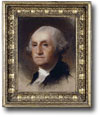 “Whereas it is the duty of all nations to acknowledge the providence of Almighty God, to obey His will, to be grateful for His benefits, and humbly to implore His protection and favor; and Whereas both Houses of Congress have, by their joint committee, requested me “to recommend to the people of the United States a day of public thanksgiving and prayer, to be observed by acknowledging with grateful hearts the many and signal favors of Almighty God, especially by affording them an opportunity peaceably to establish a form of government for their safety and happiness:”
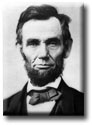 .. Abraham Lincoln was a man who learned to face discouragement and move beyond it. Did you know that it was Abraham Lincoln who, in the midst of the Civil War, in 1863, established the annual celebration of Thanksgiving?