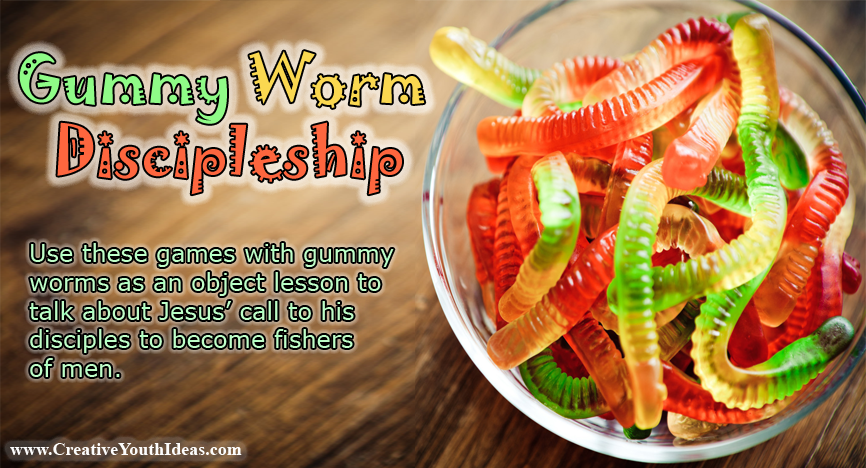
Gummy Worm Discipleship

Gummy Worm Discipleship
Although gummy bears were invented by German Candy maker Hans Reigel in 1922, the gummy worm is a relatively recent concept. The Gummy bear wasn’t shipped to America until around 1981 and then an American candy company extended the idea to gummy worms to give youth something fun to eat and to shock their parents. Gummy worms are one of the most popular gummy candies around. Use these games with gummy worms as an object lesson to talk about Jesus’ call to his disciples to become fishers of men.

PLEASE SHARE THIS IDEA ON FACEBOOK – CLICK HERE


What You Need

Lots of Gummy Worms

Games using Gummy Worms

NOTE: The intention is for these youth games to be played with gummy worms, but if you can’t get gummy worms, you can use extra long Twizzlers, or string licorice.

  • Chicken Races – In this crazy youth game, everyone is a chicken. Place gummy worms in a shallow baking pan with crushed Oreos piled on top and place it at the opposite end of the room. You can use one pan for each team or have them all fight over the worms in a single pan. On “go”, the first team member from each team must flap their arms like wings and make clucking sounds while running to the pan to collect a worm using their mouth (beaks) only. No hands allowed. Once they retrieve a worm they can return to the team and the next youth repeats the task. Worms must still be whole to be counted. The first team to have everyone retrieve a worm wins. Variation: Instead of oreo cookies, use chocolate pudding sprinkled with oreo cookies.
  • Chicken Feed – This is similar to the chicken race, but have a deeper pan with more chocolate pudding and Oreos. Each team chooses one representative. The youth who retrieves the most worms from the pan in a designated time wins.
  • Worm Fishing – To play this game you fill a fishbowl with pretzels or goldfish crackers, and the youth use a fishing rod to get one out and eat it. The bait is gummy worms that are nice and sticky. If you don’t have a real fishing rod, use a stick and some string. You could even add a reel if you wanted to. If you don’t have a fishbowl handy, any clear, large bowl will do the trick. Use lukewarm water to wet down a gummy worm and then pat it dry so that it’s nice and sticky. Tie the worm to the end of the string on the fishing rod. Players have one minute to use the wishing rod to “hook” a pretzel/goldfish from the fishbowl by getting it to stick to the ooey-gooey gummy worm. No hands allowed. Then, once one is “caught,” it must be brought back to the player’s mouth and she must eat it before the timer runs out in order to win the game. To make it more difficult, increase the distance to the fishbowl. If a pretzel/goldfish falls off the gummy worm it must be abandoned and another one “caught” on the gummy worm. If a player touches the string or gummy worm while a pretzel is attached, that pretzel won’t count. String may not be wound around the finger during an attempt. The player(s) with the most pretzels at the end of the 60-seconds wins.
  • Worms between your toes – Fill 5 or 10-gallon buckets (or kiddie pools) about 1/4 of the way up with water and drop at least 20 gummy worms in each one. Everyone takes off their socks & shoes. The first person in line for each team will run to bucket and dip their foot in the water, pulling out a worm with their toes. They must then transfer the worm into a bowl located beside the bucket. Teams only get a point for worms dropped into the bowl. Whoever has the most worms at the end of a designated time limit wins! (If you•re indoors, have some towels on hand for participants to dry their feet. You may also want to lay tarps down to minimize the mess.) Variation: Instead of a bowl, guys lie down with their heads beside buckets. The girls feed them to the guys using only their feet. The girl and guy team who can eat the most gummy bears in 2 minutes wins.
  • Gummy Worm Rulers – Provide a list of measurements in gummy worms of various items around the youth room. Youth must find the item that matches the measurements. The team with the greatest number of correctly identified items wins. (Tip: Measure the length of a typical gummy worm and then just measure things in the room with a ruler like the length of a table, the width of a door, the height of a poster, etc. Divide the measurements by the length of a typical gummy worm to get the lengths in gummy worms – 3.5 gummy worms, etc)
  • Gummy Relay – Pair up the youth. One end of a gummy bear goes into each person’s mouth. The pairs must then navigate an obstacle course without break the gummy bear or allowing it to drop from their mouths. Fastest pair wins!
  • Gummy Worm Race – Placed a marshmallow, a pretzel, or even a donut in the middle of a gummy worm. On go, players must eat their way to be the one to finish off the marshmallow. Whoever eats the marshmallow wins the game. Variation – The team who eats the worm the fastest wins!
  • Gummy Worms Pictionary – Played like normal Pictionary where you have to draw the clues for your teams to guess the word or phrase, but in this variation, instead of drawing, lay out the gummy worms to create shapes. No numbers symbols or letters are allowed. You can do it on a cookie sheet, chopping board, or butcher paper.
  • Gummy Worm Stretch – In this game, the goal is for partners to have the most stretched-out gummy worm without breaking it. Check your results with a ruler.
  • Fishies – Take a couple fishing poles and stick gummy worms to them with string. Blindfold the youth and dangle the gummy worms around. The first person to find the gummy worm with their tongue and eat it, wins.
  • Make Dirt Cups as snacks – You’ll need 8-ounce clear plastic cups, chocolate pudding mix, milk (as specified on pudding box) chocolate sandwich cookies like Oreos (crushed) and gummy worms. Mix the pudding according to the package directions. Layer the pudding and the cookie crumbs in cups. Top the layers with more crumbs and gummy worms.
  • Gummy Worm Gulpers – Youth race against the clock to eat gummy worms hanging from the ceiling. You’ll need clothespins, strong string, and lots of gummy worms. Cut various lengths of string, attach one end to the ceiling or from a tree and one end to a clothespin, and clamp a gummy worm in each clothespin. Youth run from string to string and, using only their mouths, snatch and eat the gummy worms. The winner is whoever eats all the worms in the shortest amount of time.

TAKE IT TO THE NEXT LEVEL

  • How would you describe a gummy worm to someone who has never seen or eaten one before?
  • What are some of the characteristics of gummy worms?
  • Name some uses of real worms?
  • Has anyone ever fished with a worm?

MAKE IT SPIRITUAL

Read Matthew 4:17-22

  • Worms are attractive to fish. What are some things that are attractive to people?
  • What things does the world go fishing for?
  • What are we to fish for as Christians?
  • Is a person a fisherman if year after year he never goes fishing?
  • Is he a fisherman if he never catches a fish?
  • Is someone a true disciple of Jesus Christ if he never attempts to win a soul for Christ?

MAKE IT PRACTICAL

  • As a fisherman, do we cast our nets in our backyard or do we go to a place where fish can be found? (Jesus never suggests that the world should come to the church but commands the church to go into the world to witness. Jesus has given us the example – he goes to the people, he never waits for the people to come to Him.)
  • How is telling others about Jesus similar to fishing?
  • Lures are attractive to fish. How can you make the good news of Jesus attractive to your friends?

MAKE IT PERSONAL

  • What can you do this week to be more effective as a fisher of men?

KEY SCRIPTURE

Matthew 4:19: “Come, follow me,” Jesus said, “and I will make you fishers of men.”

PLEASE SHARE THIS IDEA ON FACEBOOK – CLICK HERE

 

MORE IDEAS? See “Creative Object Lessons”

200 page e-book that explains everything you need to know when planning your very own object lessons. It contains 90 fully developed object lesson ideas and another 200 object lesson starter ideas based on Biblical idioms and Names / Descriptions of God.

Learn More…

Paper Airplane Christians

Paper Airplane Christians
It is impossible to know where and in what form the first paper airplanes were folded and flown. There is evidence to suggest it was Ancient China, or Japan. Paper was certainly available and common. Da Vinci, the Wright brothers and many others are known to have used them to understand the mysteries of flight. In this youth Bible Study, Paper airplanes are used to remind us that we also do not have to be weighed down, but can fly to great heights in our relationship with God.

PLEASE SHARE THIS IDEA ON FACEBOOK – CLICK HERE
What You Need

Rubber bands, paper clips, paper, masking tape, a measuring tape

Games using Paper Airplanes

  • Air Show – Award prizes for the following: longest flight, shortest flight, smoothest takeoff, roughest landing, highest altitude, bumpiest route, biggest loop-the-loop, widest zigzag, and most creative flight pattern, most creative design. Encourage a lot of “oohs” and “aahs” during the performances. You may wish to allow two throws or best of three, depending on time constraints.
  • Target Practice – Set up a series of rings hanging from a strong as targets. Have youth take turns trying to launch their planes so that they pass through the various size rings or hoops for points. The smaller the target the higher the points.
  • Air Race – Stretch several strings across the room, making sure that each of them is tight and will not come loose. Make several small, light airplanes, one for each string and hang each by its nose or tail by means of a hole threaded through the string. The hole should be the size of a paper punch, so that the airplane will move easily along the string (race course) Line up your contestants and at the signal “Go,” each proceeds to blow his airplane across the string and see who can reach the goal line first. Anyone who touches his airplane or the string is automatically disqualified.
  • Pass The Plane – Just like hot potato, you sit the youth in a cirle and give them a paper plane and start the music. When the music stops who ever is holding the plane is out and the game will continue til there is only one youth left.
  • Flight Plan – Create an obstacle course in the room. Obstacles can be a small table that the plane must land on, a door or window it must fly through, chairs and obstacles it must fly around, targets it must hit, things it must fly over, under, or through. Fastest time in the obstacle race wins.
  • Airplane Blitz – Bring a stack of paper and have the youth write their names, and something significant on the paper, like a favorite verse, prayer request, or something they learned at a recent youth event. They can write another one on another piece of paper (or several). Then let them make paper airplanes out of these. Then you need some way to clearly divide the room in half. (The taller the divider the better.) Put half the youth on each side of the divider. Put half the paper airplanes on each side of the divider. Explain that they can only throw ONE plane at a time and they must stop when the leader says “Stop”. On “Go”, they throw the airplanes over the divider as fast as they can. Planes are flying in both directions. When you say “stop”, count the airplanes on each side of the divider. The team with the least number of planes wins. THEN: Have each person pick up an airplane and read the fun fact on each plane while everyone else tries to guess the identity of the person.
  • Largest Paper Airplane contest – Provide butcher paper or newsprint, scissors and masking tape, and one Bible per student. Have the group design a gigantic paper airplane. sharing their paper airplane construction techniques. Have them test out some of their ideas with a normal sheet paper. When the group has decided how to design the giant airplane. have youth fold their huge piece of paper accordingly. Award prizes for the best in various categories.
  • Fewest Throws – Count how many throws it takes to get their paper airplanes across a room and land on a table. Reward the youth with the least amount of throws their airplanes took.
  • Paper Airplane Dodgeball – Play a game of dodgeball using paper airplanes. If a player is hit with a plane, he hands over his plane and is out of the game. Here are some more rules: Airplanes must be thrown. Simply touching your opponent with your airplane is considered a self-destruct and you are out of the game, forfeiting your planes to your opponent. Airplanes cannot be picked up until they stop moving. (They can’t be stopped with your foot, either.)

TAKE IT TO THE NEXT LEVEL

  • Were you focused on trying to achieve a specific award or did you just create a general purpose plane? Why?
  • What were the key characteristics of your design? Why?
  • What were the keys to success for each award category?

MAKE IT SPIRITUAL

  • In what ways are the paper airplanes similar to people? Similar to Christians?

MAKE IT PRACTICAL

  • The Scriptures in Isaiah 40:31 promise us eagle wings as we wait on God. What does that mean?
  • What things keep us spiritually grounded / prevent us from soaring as high as we can as a Christian?
  • What things weigh us down spiritually?
  • How can we lighten our load?
  • What purpose do goals serve in helping us to reach a higher calling in the Christian life?
  • What goals did Paul have in life, what did he aspire to reach in life?
  • What were Christ’s goals?
  • What factors / keys to success make someone a winner in the Christian life?
  • What things can we people to be more successful?
  • When it comes to accuracy, the word “sin” means “to miss the mark” as we all have done. Romans 3:23 says “For all have sinned and fallen short of the glory of God.” Every one of us has sinned against God and missed the mark of God’s perfection. What are some things that cause us to miss our goal as Christians? How do we recover?

MAKE IT PERSONAL

  • What are your goals in life? As a Christian?
  • Do you have just one goal or many goals? Why?
  • Which goal is most important to you? Why?
  • How are you similar / different in your goals as compared to Paul / Christ?
  • What do you need to change to be more successful as a Christian?

SCRIPTURE

  • Exodus 19:4 – “Ye have seen what I did unto the Egyptians, and how I bare you on eagles’ wings, and brought you unto myself.”
  • Isaiah 40:31 (NIV) – “but those who hope in the Lord will renew their strength. They will soar on wings like eagles; they will run and not grow weary, they will walk and not be faint.”
  • 1 Corinthians 9:24-27 (NIV) – “Do you not know that in a race all the runners run, but only one gets the prize? Run in such a way as to get the prize. Everyone who competes in the games goes into strict training. They do it to get a crown that will not last, but we do it to get a crown that will last forever. Therefore I do not run like someone running aimlessly; I do not fight like a boxer beating the air. No, I strike a blow to my body and make it my slave so that after I have preached to others, I myself will not be disqualified for the prize.”
  • Matthew 11:30 – “For my yoke is easy and my burden is light.”
  • John 8:31-36 (NIV) – “To the Jews who had believed him, Jesus said, “If you hold to my teaching, you are really my disciples. Then you will know the truth, and the truth will set you free.” They answered him, “We are Abraham’s descendants and have never been slaves of anyone. How can you say that we shall be set free?” Jesus replied, “Very truly I tell you, everyone who sins is a slave to sin. Now a slave has no permanent place in the family, but a son belongs to it forever. So if the Son sets you free, you will be free indeed.”
  • Ephesians 4:11-14 (NIV) – “So Christ himself gave the apostles, the prophets, the evangelists, the pastors and teachers, to equip his people for works of service, so that the body of Christ may be built up until we all reach unity in the faith and in the knowledge of the Son of God and become mature, attaining to the whole measure of the fullness of Christ. Then we will no longer be infants, tossed back and forth by the waves, and blown here and there by every wind of teaching and by the cunning and craftiness of people in their deceitful scheming.”

PLEASE SHARE THIS IDEA ON FACEBOOK – CLICK HERE


MORE IDEAS? See “Creative Object Lessons”

200 page e-book that explains everything you need to know when planning your very own object lessons. It contains 90 fully developed object lesson ideas and another 200 object lesson starter ideas based on Biblical idioms and Names / Descriptions of God.

Learn More…

Masked?

Masked

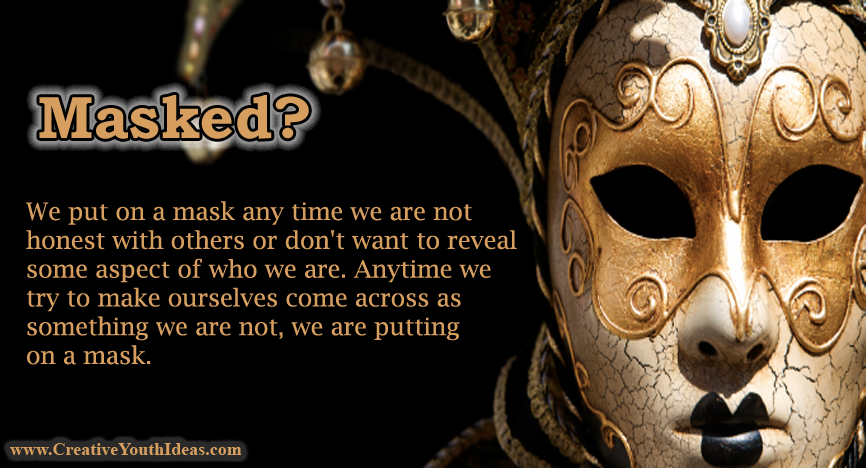
It’s not just Halloween that people wear masks. If we are honest with ourselves, most of us put on masks from time to time. We put on a mask any time we are not honest with others or don’t want to reveal some aspect of who we are. Anytime we try to make ourselves come across as something we are not, we are putting on a mask.

PLEASE SHARE THIS IDEA ON FACEBOOK – CLICK HERE

Games using masks

  • Masked Games – You can play just about any favorite youth game but add masks to the game for a twist and to tie into the lesson. The mask limits your vision and adds an interesting twist to the favorite game.
  • Find the masks – Hide various masks around the youth room. Youth must search the room and note the locations of all the visible masks. First youth to get the correct answer and identify all the locations wins.
  • Masked Man Relay – Buy a variety of hats, wigs and masks or maybe some sunglasses or other fun eye wear … anything and everything your guests can use to decorate themselves. Use non-offensive costumes like superheroes, hobo, clown, farmer brown, a prince or princess, scarecrow, hippie, animals, disney characters etc. Clothes should be large enough to fit easily over what youth are already wearing. Have one set for each team. Place all the props on a table. One by one each team member must run to their team’s table, put on all the props, and then return team and remove them. The next player then puts them all on, runs to the table, removes them and places them back on the table then returns to the team. First team to complete the relay wins. (Note: be sure to take a photo as each one gets costumed up.)
  • Quick Change Artists – Get a veriety of costumes. Use non-offensive costumes like superheroes, hobo, clown, farmer brown, a prince or princess, hippie, scarecrow, animals, disney characters etc. Have one set for each team. In this relay each team must use all the costumes givem to them to dress up their team members. One costume is in each bag. First team to get all the costumes onto team members wins.
  • Create a Mummy Challenge – All you need to play this game is a roll of white crepe paper, toilet paper works in a pinch. Divide the youth into teams of two and have one person be the mummy and one person be the mummy wrapper. Time the kids and the first group to completely wrap up their mummy wins and receives a prize.
  • Masked Bobbing for apples – Put a large tub, baby bath, or small kiddie pool full of water on the floor – it will be very heavy when it is full, so either do this outside or have some method of emptying it. If you are doing this inside take care to cover the whole area with plastic otherwise the floor will get very wet. Float the apples in the water, pulling all the stalks off the apples makes the game harder. The size of the apples is important, if older youth are playing then you will need big apples, small ones fit into their mouth too easily. The contestants have to wear masks and kneel beside the tub and grab the apples with their teeth. The water must be deep enough or some people will cheat by pushing the apple against the base of the tub. It’s simple! The first person to get an apple out – WITHOUT USING THEIR HANDS – is the winner.
  • Masked apples on a string – You will need apples and string. Tie the string to the stalk of the apple. Tie the other end of the apple to something high; you could hang these from the banisters of your stairs (only above a flat surface, it’s not safe to play games on stairs), or pin the strings to beams. On the word “GO” the winner is the first person to take a big bite out of their apple without using their hands.
  • Monster Mash – Pick an area that free of obstacles and dangerous corners. You can do it in a room with leaders blocking off any dangerous areas. The monster wears a monster mask and monster hands. They also have a mask with the eye openings covered up placed over their eyes, they aren’t supposed to see. This is a hearing and touching game. All players have to stay within the game area while the monster wanders around with their arms reaching out to catch the players. When the “monster” moans or growls, all the players must moan or growl back and extend their arms. This is how the “monster” finds his/her victims. When a player gets tagged, they becomes the next “monster” and gets to wear the mask.
  • Guess the Ghost – This game is guaranteed to be great fun. Sit the youth in a circle, put some music on and get them to take it in turns to be blindfolded with a mask with the eyes covered over so they cannot see. The masked person walks around the circle touching the other youth on the head. When the music stops, the youth who is currently tapped on the head has to let out their scariest ghostly wail. The masked person then has to guess who they think it is. Hand out rewards to people who guess correctly.

TAKE IT TO THE NEXT LEVEL

  • If you could be any superhero who would you be?
  • What is it about this character that attracts you?
  • Why do most of the superheroes wear masks?

MAKE IT SPRITUAL

The word for an actor is the word ‘hypocrite’ in the Greek language. It means ‘the person who wears a mask’ (or covers on his face). In the original Greek plays, actors pretended to be someone else by putting on a mask.

Jesus used the word ‘hypocrite’ to describe the Pharisees and in a parable teaches us an important lesson about masks… (see Luke 18:9-14)

  • Why was the Pharisee called a hypocrite – one wearing a mask?
  • Why do you think the Pharisee ‘acted’ this way?
  • Have you met people like the Pharisee? How did they make you feel?
  • In what ways are you like a Pharisee? What are some of your masks?
  • Why is the Tax-collector unwilling to even look up to heaven? Have you ever been so ashamed that you wanted to hide your face from heaven? How is this similar to wearing a mask?
  • How is it different from the mask of the Pharisee?
  • What is Jesus’ main point in this story?

MAKE IT PRACTICAL 

  • What are examples of the different masks people put on?
  • What are some of the reasons people wear masks?
  • How do masks help or hinder us?
  • In what situations do people hide behind a mask, afraid to reveal who they really are and what they really feel?

MAKE IT PERSONAL

  1. Give each participant a piece of paper cut into a mask shape.
  2. On one side, ask them to write or draw characteristics of how they want people to see them.
  3. Then, on the other side, ask them to write down some true characteristics of who they really are and some of the things about their life that they don’t want other people to see.
  • Is there a difference between the two sides of the mask?
  • What are the risks of revealing what is hidden behind the mask?
  • Are there certain things about yourself that you prefer to hide?
  • What are the benefits of hiding behind a mask?
  • In what areas of your life do you need to be honest with God?
  • How would being honest with God make a difference in your life?
  • Is there a mask you would like to remove?

Action Point
Let participants crumple up their mask and toss it away. Name one truth about yourself that may be hidden, but that you would like people to know.

SCRIPTURE

  • Matthew 23:27
  • Luke 18:9-14

PLEASE SHARE THIS IDEA ON FACEBOOK – CLICK HERE


Get Creative Youth Ideas: "Holiday Collection" ebook Creative Holiday Ideas
Games and Activities in Celebration of common Holidays.

Creative Holiday Ideas has over 300 pages of ideas to help you plan not only your next Fall Festival or Halloween Alternative event, but also most of the other common holidays. If you’ve ever wondered what you’re going to do for the holidays and how you’re going to do it, this resource is for you.

=> Tell me more about the Holiday Collection

Candy Corn Choices

Candy Corn ChoicesCandy corn is the top-selling Halloween candy and the most talked about candy during Halloween, but it is also talked about as the worst candy for you. Candy Corn isn’t real corn. It is almost pure sugar – a sweet imitation of the real thing which isn’t good for us in any way. So it’s good, but it’s bad. How do we decide what things are good for us in our Christian life? The most difficult decisions are often not between what is good and bad, but between what is permissible and what is beneficial to us.

PLEASE SHARE THIS IDEA ON FACEBOOK – CLICK HERE

Candy Corn Games

  • Candy Corn Cluckers – Fill a bowl with dried corn kernels or peanuts and add several pieces of candy corn. Blindfolded youth must retrieve the candy corn from the bowl within a designate amount of time without eating the dried corn kernels / nuts. The teen that retrieves the most candy corn in the designated time limit wins.
  • Candy Corn Pitching – Youth take turns pitching ten to twenty candy corn kernels, one at a time, into a bowl from a set distance. You might choose to have various bowls of different sizes and at different distances. Display the points based upon difficulty. Keep score of how many kernels end up in the various bowls. The winner is the youth with the highest score after three rounds.
  • Odds or Evens  – Each player starts out with the same number of candy corn kernels. Players rotate about the room pairing up with others. When they find a partner, one youth hides a few kernels of candy corn in his hand. The other youth must guess if the number of corn kernels is odd or even. If guessed correctly, the player can add the kernels to his own collection. Youth take turns hiding and guessing, until one player has all the corn or until a specified time limit! [With this game the candy corn can get a little messy 🙂 to avoid the mess use individually wrapped mints or other candy.]
  • Candy Corn Drop – Have the youth stand on a sturdy chair or other safe elevation and drop the pieces down into a person’s mouth who is lying on the floor. The youth who gets the most candy corn into the person’s mouth in a given time frame wins.
  • Candy Corn Toss – Place the pieces of candy corn into a small sealed sandwich bag or similar cellophane bag and have a “candy corn bag” toss. Number pails, bowls, or plastic pumpkins, placing them in a row perpendicular to A start line, pail number one being closest. youth stand behind the line and throw candy cord bags into each consecutive bucket. Keep score or issue prizes for hitting each target.
  • Candy Corn Bocce – On a smooth surface like a table, one youth acts as the referee, sliding out the first piece of candy corn. He then marks this piece with a toothpick. Contestants take turns sliding 4 different pieces as close to the referee’s mark as they can. The referee determines which piece is the closest, awarding that youth or team a point. Play until someone gets ten points.
  • Candy Corn Hunt – Fill small plastic bags with candy corn and hide them throughout the yard. Send players out into the yard to find the bags until every bag has been claimed. You may also divide the players up into groups and see which group can find the most bags. This game can also be played inside, or at night with flashlights.
  • Corny Scramble – Toss handfuls of candy corn onto a large table clear of obstacles. Give each youth a treat bag and make the scramblers wait until you say “Boo!” On the signal, the players must run forward and collect as many pieces of candy corn as possible. Once all the kernels have been picked up, see who has the most candy in his bag.
  • Guess the Kernels – Fill a decorated jar or Halloween treat pail with pieces of candy corn, making sure you count how many pieces you put into the container. Set the container up on a table supplied with slips of paper, pencils and a bucket to put the paper slips into. Each participant may take one guess at how many pieces of candy are inside the container. The player who guesses the closest to the actual amount wins all the candy corn.
  • Kernel Relay – Mark a starting line and a finish line with masking tape on the floor roughly 15 feet apart. Set an empty bowl for each player at the finish line and a bag of candy corn and a spoon at the starting line. Have each player stand at a bag of corn and take the spoon in hand, placing a single kernel on the spoon. The youth will then carefully race a piece of corn to an empty bowl at the finish line, trying not to let the candy fall off the spoon. Each player will continue to race from the bag of corn to the bowl to see how many pieces of candy she or he can get into the bowl within the allotted time of one minute. If a player drops a kernel from the spoon, that youth must then run back to the bag of candy corn and get another piece to start over again.
  • Candy Corn and Straws Relay – Divide the youth into teams and give every person on a team a plastic straw and a paper cup. Place a piece of candy corn in the first team member’s cup. The youth must create a vacuum in the straw to pick up the candy corn and place it into the next person’s cup. First team to get the candy corn into the last person’s cup wins. If the candy corn is dropped on the floor, the team must start completely over at the beginning.
  • Where’s the Corn? – Line up three plastic cups out on a tabletop in front of a youth. Place a single piece of candy corn under one of the cups, allowing the player to see which cup the corn is under. Begin to change the cups’ formation around for five to ten seconds. The youth then must try to remember which cup is hiding the candy and will continue to play and collect candy corn until he or she chooses the wrong cup. Give the earned candy corn to that player, and continue on with the next player until every youth has won pieces of candy.
  • Candy Corn and Spoons – Divide into teams, have each team to line up single file, and have a cup with one or more pieces of candy corn for each team. Give each player a spoon. The first player on each team picks up a piece of candy corn with the spoon, spins around in place 3 times, then passes the candy to the next person on the team. Candy Corn can only be touched with the spoon. If the candy is dropped the team must start over again from the beginning. First team to get all the marbles down the line wins.
  • Chopsticks and Candy Corn – Using a pair of chopsticks and a couple shallow bowls or saucers, each youth is given one minute to move candy corn from one bowl to the other using only the chopsticks. Only one hand can be used to hold the chopsticks. The youth to transfer the most candy corn wins.
  • Tick-Tack-Corn – Pair the youth up into groups of two and sit them down at a table across from each other. Give the pair a tick-tack-toe board, and one player a handful of regular candy corn pieces. The other youth will receive a handful of the chocolate variety of candy corn, making one player the yellow team and the other player the brown team. Have the players play tick-tack-toe using their corn until one player wins, or until there is a draw. This may continue for as many rounds as desired.
  • Musical Candy Corn – Fill treat bags with candy corn for as many youth as are playing, minus one. Set the bags up in a circle on a tabletop or floor. Have the players circle around the bags at a steady walking pace while some music plays. Stop the music at random, at which point each player tries to grab the bag closest to him. Whoever fails to grab a bag or candy corn in time is out of the game, and the players still in must set the bags back up in the circle. Remove one of the bags from the circle, then start the music up again. Continue this until the game is down between two players and one treat bag. Whoever snatches up the last bag is the game winner.
  • Candy Corn Foosball – Have two youth stand at either end of a large table. One youth throws candy corn (or a plastic bag of it) to the other end of the table, and the other youth must block it from going through and making a goal. Use a dry sponge for blocking making sure it is one that will not scratch your table.
  • Candy Corn Straw Relay – Race to see who could move the most candy corn from the table into a bowl in sixty seconds using only a single straw.
  • Candy Corn Catch – You’ll need one plastic pumpkin with a handle for each team, one bag of candy corn per team, and a belt or length of rope for each team. Use the rope or belt to secure the pumpkin around the waist of one player per team. Have the team member who is wearing the pumpkin stand about 7 to 10 feet away from the players who will be throwing the candy corn. The player wearing the pumpkin may move around to try and catch the candy corn as it is thrown without using their hands to deflect the candy corn in any way. Once everyone has thrown the candy corn, take the pumpkin and count the candy corn inside. The youth with the most candy corn wins.

TAKE IT TO THE NEXT LEVEL

MAKE IT SPIRITUAL

  • What are some of the differences between real corn and candy corn?
  • Which is good for you? Bad for you?
  • What other things in life are good for you? Bad for you?
  • How do you know the difference?

Candy corn may not kill you, but it most certainly is not the best for you. It may taste sweet, but the sugar rush doesn’t last and it really isn’t something that is good for you. Corn is healthy and good for us, but candy corn, is really just sugar. It’s a sweet imitation of something good. In life there are many things which may seem good, but are not good for us. BUT how can we decide what is good for us and what is not?

MAKE IT PRACTICAL

Some decisions are not simply a matter of right and wrong, but a choice between what is permissable, what is good, and what is best. These are often the toughest decisions.

Here are some guidelines:

  • Is this action Scripturally based–does Scripture support or condemn it (Matthew 4:4, 7, 10; I Timothy 3:16-17)?
  • How would this affect my witness for Christ if others knew about it (Matthew 5:13-16; I Thessalonians 5:21-22)?
  • Would Jesus put his name on this for a stamp of approval? (Colossians 3:17)
  • Does this fall into the classification of good thinking? (Philippians 4:8)
  • Will this degrade or defile my body (the temple of the Holy Spirit)? (I Corinthians 6:19)
  • Will this sooner or later make a slave out of me? (I Corinthians 9:27, 2 Peter 2:19)
  • Does this have the “smell” of evil on it? (1 Thessalonians 5:22)
  • Will my indulgence in this tend to weaken someone’s faith? (I Corinthians 8:13)
  • Does it benefit us or others? (I Corinthians 6:12a, 10:23)
  • Can you do it with a clear conscience? (Romans 14:22)
  • Does it bring Glory to God, meet his approval? (1 Corinthians 6:19-20; 10:31-33; 2 Corinthians 5:9)
  • Does it help lead others to Christ? (1 Corinthians 10:33)
  • Would I be ashamed to be doing this thing when Christ returns (Matthew 24:42-46)?
  • Does this action hurt others (Romans 14:20-21; Galatians 5:13-15)?

MAKE IT PERSONAL

  • What are some of the things I allow as substitutes in my life for the real things?
  • Which of the above considerations is new to me?
  • Which of the above considerations is most difficult for me?
  • What can I do this week to be more Christlike?
  • How can I allow Christ to have more influence in the daily decisions of my life?

SCRIPTURE

1 Corinthians 10:31-11:1 – “So whether you eat or drink or whatever you do, do it all for the glory of God. Do not cause anyone to stumble, whether Jews, Greeks or the church of God – even as I try to please everyone in every way. For I am not seeking my own good but the good of many, so that they may be saved. Follow my example, as I follow the example of Christ.”

ROMANS 12:2 – “Do not conform any longer to the pattern of this world, but be transformed by the renewing of your mind. Then you will be able to test and approve what God’s will is – His good, pleasing and perfect will.”

PLEASE SHARE THIS IDEA ON FACEBOOK – CLICK HERE


Get Creative Youth Ideas: "Holiday Collection" ebook Creative Holiday Ideas
Games and Activities in Celebration of common Holidays.

Creative Holiday Ideas has over 300 pages of ideas to help you plan not only your next Fall Festival or Halloween Alternative event, but also most of the other common holidays. If you’ve ever wondered what you’re going to do for the holidays and how you’re going to do it, this resource is for you.

=> Tell me more about the Holiday Collection

Christian Pumpkins? – Games and an Object Lesson

Christian PumpkinsPumpkins are closely associated with Halloween, Harvest, and Thanksgiving and are most likely native to the Americas. In this week’s lesson you’ll find a lot of game ideas using pumpkins, and also a reminder that God looks at the inside and not merely whats on the outside. He wants us to have a clean heart. Like a like shining from inside the pumpkin, he also wants us to shine out to the world.

PLEASE SHARE THIS IDEA ON FACEBOOK – CLICK HERE

Pumpkin Games

  • Capture the Pumpkin – For this Pumpkin-themed version of capture the flag, divide the teens into two teams, each with a territory, a jail and a pumpkin. The teens can choose to place the pumpkin anywhere on their territory, but it must be visible. While teams can assign people to guard the pumpkin, you must set a perimeter around it that they cannot enter to give the other team a chance to capture it. The goal is to steal the other team’s pumpkin and make it back to your own territory without getting tagged. If anyone is tagged on another team’s territory, they are sent to jail. Other team members can free them if they can manage to tag them and both make it safely back to their territory. If no one has captured a pumpkin within a certain time frame, determine a winner by the number of prisoners a team has. This game is best played in a large park with plenty of hiding places.
  • Card Ninja – Players must throw playing cards at a pumpkin trying to get one card to stick in the pumpkin before one minute is up.
  • Connect The Pumpkin – This game is especially good around Halloween but can be played any time. Purchase some pumpkins and cut them up into pieces (make sure the pieces are not too small). Next to the pieces of pumpkin place a set of wooden toothpicks. Once everyone is ready instruct the group to put the pumpkin together using the toothpicks. Give the group a set time limit and ask them to begin. The team with the pumpkin that has been best put together wins.
  • Elephant March – Knock over plastic bottles filled with sand using a small pumpkin hanging from panty hose worn around the head.
  • Pass the Pumpkin – This game is a variation on “hot potato”. Seat the youth on the floor in a circle. Give them a small pumpkin to pass around. Play music as they pass the pumpkin, and periodically stop the music. Whoever is holding the pumpkin is out. The game continues until one person is left with the pumpkin.
  • Pass the Pumpkin – Youth tuck a small pumpkin under their chin and shoulder, race to their teammate, and pass the pumpkin to them without using their hands. If the pumpkin is dropped, it can be put back into place using hands.
  • Pin the Nose on the Pumpkin – Using a Black Marker, Draw a face on a pumpkin but leave off the nose. In turn, blindfold each youth and give them a black cutout shape of a nose with double-side tape on the back. Youth must pin the nose on the pumpkin. Closest wins. (You might want to have the nose draw as well. The one who pins the nose most accurately over the drawing wins.)
  • Pumpkin Bocce Ball – Place the big pumpkin several feet away. Give each player a small pumpkin. Each player rolls (No tossing or throwing) their pumpkin and tries to be the closest to the big pumpkin. The player closest wins …
  • Pumpkin Carving Contest – Working as teams, youth create the winning carvings for categories such as funniest, spookiest and most beautiful pumpkin. If you have young kids without adult participation, hold a pumpkin painting contest instead.
  • Pumpkin Golf – Played just like miniature golf where you use putters to hit the golf ball into the pumpkins mouth rather than a cup. To create a pumpkin golf pumpkin, you’ll need to cut off the bottom of the pumpkin and then clean out the inside of the pumpkin and then add the mouth to the pumpkin. The pumpkin’s mouth will also serve as the entry point for the golf ball so the mouth must be at the bottom of the pumpkin. Then create the eyes and nose just as you would a normal pumpkin.
  • Pumpkin Penny Toss – Carve out a large pumpkin, making a wide opening at the top. Give the youths a limited number of pennies. Have them stand an appropriate distance from the pumpkin and try to toss the pennies in, one at a time. Whoever gets the most inside wins.
  • Pumpkin Relay – Teams race to be the first to pass the miniature pumpkins to the end of the line without using their hands. If the pumpkin is dropped they must start over again.
  • Pumpkin Ring Toss – Toss rings over pumpkins with stems.
  • Pumpkin Roll – You need two large pumpkins and two sturdy sticks (or brooms). The racers, line up on the starting line with the pumpkins turned on their sides. On the signal, the racers use the stick to roll the pumpkins to the finish line. Since pumpkins are uneven, they rarely roll straight.
  • Pumpkin Roll Icebreaker – With a permanent marker, write some icebreaker questions on a pumpkin until the surface is covered. These can be simple things like your “favorite fall vegetable?” or more personal things like “the scariest moment in your life?”. Then sit the youth on the floor in a circle. Youth roll the pumpkin to each other, but they rarely roll in a straight line. The person closest to the pumpkin must catch it. When caught, the question your thumb lands on is yours. Answer the question then roll it on to someone else, so they can take a turn.
  • Pumpkin Seed Count – Divide the class into teams of two to four and cut the top off of a pumpkin for each team. Tell the teams that the first team to scoop out and count 50 pumpkin seeds is the winner.
  • Pumpkin Stackers – Stack five pumpkins on top of each other without them falling in the quickest time.
  • Pumpkin Toss – Ask the first player to stand 3 to 4 feet away from a deep wicker basket and give him or her 10 to 20 mini pumpkins. See how many can be tossed into the basket in 30 seconds. In the event of a tie, let the finalists compete for the win by determining which one can make 10 baskets in the shortest time.
  • Pumpkin Transport – Tie five to eight long cord/string pieces (4-6 feet long) to a large ring. Place the ring on the ground with the cords coming out from it like rays of sunshine. Place a small pumpkin on top of the washer. The challenge is for the youth to pick up the ring and pumpkin by hanging onto the strings only without the pumpkin falling off.

TAKE IT TO THE NEXT LEVEL

MAKE IT SPIRITUAL

  • How can pumpkins represent us as Christians?

Just like us, pumpkins are different. God picks you from the patch, brings you in, and washes all the dirt off of you. Then he cuts off the top and scoops out all the yucky stuff. He removes the seeds of doubt, hate, greed, etc., and then he carves you a new smiling face and puts His light inside of you to shine for all the world to see.

  • How do the following verses relate to Pumpkins and to our lives as Christians?
    • 1 Samuel 16:7 – “The LORD does not look at the things man looks at. Man looks at the outward appearance, but the LORD looks at the heart”
    • Matthew 23:25-28 – “Woe to you, teachers of the law and Pharisees, you hypocrites! You clean the outside of the cup and dish, but inside they are full of greed and self-indulgence. Blind Pharisee! First clean the inside of the cup and dish, and then the outside also will be clean. Woe to you, teachers of the law and Pharisees, you hypocrites! You are like whitewashed tombs, which look beautiful on the outside but on the inside are full of the bones of the dead and everything unclean. In the same way, on the outside you appear to people as righteous but on the inside you are full of hypocrisy and wickedness.”
    • Jeremiah 17:10 – “I the Lord search the heart and examine the mind to reward according to conduct and deeds.”
    • Psalm 51:10 – “Create in me a pure heart, O God.”
    • Matthew 5:14-16 – “You are the light of the world. A town built on a hill cannot be hidden. Neither do people light a lamp and put it under a bowl. Instead they put it on its stand, and it gives light to everyone in the house. In the same way, let your light shine before others, that they may see your good deeds and glorify your Father in heaven.”
    • John 8:12 – “When Jesus spoke again to the people, he said, “I am the light of the world. Whoever follows me will never walk in darkness, but will have the light of life.”
    • 2 Corinthians 4:6 – “For God, who said, “Let light shine out of darkness,” made his light shine in our hearts to give us the light of the knowledge of the glory of God in the face of Christ.”
    • 2 Corinthians 5:17 – “Therefore, if anyone is in Christ, he is a new creation; the old has gone, the new has come!”
    • 2 Corinthians 4:7-10 – “But we have this treasure in jars of clay to show that this all-surpassing power is from God and not from us. We are hard pressed on every side, but not crushed; perplexed, but not in despair; persecuted, but not abandoned; struck down, but not destroyed. We always carry around in our body the death of Jesus, so that the life of Jesus may also be revealed in our body.”

MAKE IT PRACTICAL

  • How is the way we clean out A pumpkin like the way Jesus cleans us out when we confess our sins?
  • What happens when we hide our light so others can’t see it?
  • What lessons can we learn from Pumpkins?

MAKE IT PERSONAL

  • What can you do to maintain a clean heart?
  • What can you do this week to have your light shine brighter for Christ?

PLEASE SHARE THIS IDEA ON FACEBOOK – CLICK HERE

Get Creative Youth Ideas: "Holiday Collection" ebook Creative Holiday Ideas
Games and Activities in Celebration of common Holidays.

Creative Holiday Ideas has over 300 pages of ideas to help you plan not only your next Fall Festival or Halloween Alternative event, but also most of the other common holidays. If you’ve ever wondered what you’re going to do for the holidays and how you’re going to do it, this resource is for you.

=> Tell me more about the Holiday Collection

Living Skeletons

Living Skeletons
Even if you don’t want to be involved with Halloween, you’ll want to grab at least one of those plastic or paper Halloween skeletons for this object lesson and games.

PLEASE SHARE THIS IDEA ON FACEBOOK – Living Skeletons

Skeleton Games

Preparation: Purchase one or more plastic skeletons commonly found during the Halloween holiday season. You can also use a paper skeleton that is already cut into parts or make your own. Separate the plastic skeleton parts into pieces or cut them out if they are on paper.

  • Build the Skeleton – Obtain one skeleton for each team. Place all the parts for each skeleton in its own sack and give one sack to each team. When you say ‘Go’, each team must take out the skeleton parts and correctly reconstruct the skeletons. Award prizes for the fastest times. You can also give additional prizes for weirdest skeleton, etc.
  • Skeleton Scavenger Hunt – Hide the skeleton bones before the lesson starts. Let the participants search for them and then reassemble the skeleton. For older youth, you can hide the bones and then write out clues for them to follow to find them. You can also get a few skeletons and break the kids into teams. You can have it as a free for all (i.e. hide all parts and award the first team to find one of each part and put the skeleton together), or you can add a spot of color or a colored ribbon to identify which skeletons belong to which team. Team members must first find a complete set of parts… then they must assemble it correctly.
  • Skeleton Hoop Toss – This game requires a plastic-molded skeleton, positioned upright, and three plastic hula-type hoops. Mark a place where youth teams must stand. Each youth attempts to toss the three hoops over the skeleton. The player who tosses the most hoops over the skeleton wins.
  • Blind Skeleton Assembly – Place all the parts for each skeleton in its own sack and give one sack to each team. Each team chooses one team member to be blindfolded. When you say ‘Go’, the blindfolded person must correctly reconstruct the skeleton according to directions given by his or her team. First team to finish wins.
  • Skeleton Posers – Hang a Skeleton up and then using poster tape, pose the skeletons in different positions and take a picture of each pose. Have fun by placing all the Skeleton’s hands in the air, holding hands, legs positioned like doing a split and so on. You’ll want 20 to 30 different skeleton poses for the game. Take the photos and print out the pictures to create your Skeleton posing cards. When a card is drawn, the first team to pose the skeleton in the correct position wins. Variation: The team chooses one person (who is not allowed to see the photo) to help pose the skeleton according to directions given by the team, so it matches the photo. Variation: Teams are given 3 minutes to see how many Skeleton Poses they can create, the team with the most Poses made in 3 minutes wins.

TAKE IT TO THE NEXT LEVEL

One of the scary things about Halloween is the skeletons. A lot of people are afraid of death. When they see bones it reminds them of death and they become afraid. But they are just bones and there is nothing to be scared about. They can’t come to life right? Or can they?

The prophet Ezekiel might have had the first Halloween scare! We don’t know what day it took place, but it probably wasn’t October 31st. Let’s look at Ezekiel 37 to find out more!

MAKE IT SPIRITUAL

Read the key verses from this vision. God’s question to Ezekiel, “Can these dry bones live?” (v3) might be a question a lot of youth ask on 31st of October.

God was talking about more than a skeleton in a closet. He was giving Ezekiel a glimpse into the future when Jesus would conquer death and bring life to us. Jesus did conquer death on a cross. He also resurrected Lazarus from the dead.

Yet God was giving Ezekiel a picture of something more.

The bones represented the house of Israel and their dryness and loss of hope. (v11) The spirit of God would enter their bodies and they would experience restoration and life.

MAKE IT PRACTICAL

There may situations in life when people feel like a pile of dry bones. A new life may seem impossible.

  • What are some of the seemingly impossible situations youth / people face in life?

Like Ezekiel’s response to God when asked “Can these bones live?”, we can answer “You alone know.” God knows all and with God all things are possible. God can breath life into any situation we are in. Not only can he bring you a new life, but he can also give you a new heart: “I will give you a new heart and put a new spirit in you; I will remove from you your heart of stone and give you a heart of flesh. And I will put my Spirit in you and move you to follow my decrees and be careful to keep my laws. (Ezekiel 36:26-27).

  • We are all dead in our sin, like a pile of dry bones (Ephesians 2:1)
  • But God, because of his great love for us, makes us alive in Christ (Ephesians 2:4-5)
  • We experience new life through faith in Christ! Doing good things doesn’t get us eternal life, but we are made alive in Christ that we might do good things for Him. (Ephesians 2:8-10)

MAKE IT PERSONAL

  • Have there been times in your own life when you feel like a pile of dry bones?
  • How can knowing that God can bring even piles of bones back to life give you hope in hopeless situations?
  • How can Christ’s resurrection give you hope in hopeless situations?

SCRIPTURE VERSES

  • Ezekiel 37
  • Ezekiel 36:26-27
  • Ephesians 2:1
  • Ephesians 2:4-5
  • Ephesians 2:8-10

PLEASE SHARE THIS IDEA ON FACEBOOK – Living Skeletons


Get Creative Youth Ideas: "Holiday Collection" ebook Creative Holiday Ideas
Games and Activities in Celebration of common Holidays.

Creative Holiday Ideas has over 300 pages of ideas to help you plan not only your next Fall Festival or Halloween Alternative event, but also most of the other common holidays. If you’ve ever wondered what you’re going to do for the holidays and how you’re going to do it, this resource is for you.

=> Tell me more about the Holiday Collection

Clay in the Potter’s Hands

Clay in the Potter’s Hands

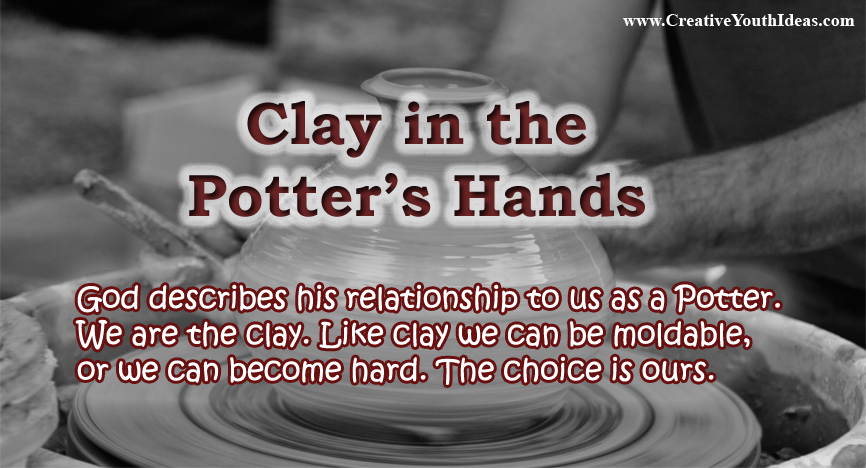
A Lump of clay is chosen with a purpose in mind. The potter envisions a vessel that will be useful to its final owner and a credit to the potter’s craftsmanship and experience. The potter applies pressure to the clay in different ways shaping and forming it until the final product he imagined is realized. The Bible tells us Adam was made from clay. God describes his relationship to us as a Potter. We are the clay. Like clay we can be mouldable, or we can become hard. The choice is ours.

PLEASE SHARE “Clay in the Potter’s Hands” ON FACEBOOK

Games Using Clay or Playdoh

Note: Playdoh, while generally easy to remove can get mashed into carpets and leave bihind residue on some objects. You’ll want to make sure you use it in a way so that cleanup presents no problems.

  • Best impressions – Give youth some playdoh and send them on a scavenger hunt to obtain impressions of various objects in the clay/ playdoh. You can put things on your list like 5 different size coins, comb, leaf, key, button, pen cap, bottle cap, can tab, fork, shell, dog-tag, chess piece, cross, earring, paper clip, tweesers, action figure, bug, small lightbulb, lego, marble, battery, chain, rope, pencil, pair of dice, monopoly piece, checkers, wrench, nail, screw, watch, belt buckle, thimble, safety pin, whistle, lifesaver, golf ball, a letter, word from an engraving, etc. Add your own.
  • Clay Bowling – Have youth make balls from the clay / playdoh. See which one can get their ball to roll the farthest, or the straightest…. Or get closest to a target.
  • Longest snake – Which team can roll our the longest snake given the same amount of clay.
  • Great Minds Think Alike – Provide each of the youth with a tub of play dough. Have all the youth sit in a circle with their backs to each other. Call out a theme; example Animal, Shape, Candy, Letter, Pastry, etc. Give the players 1 minute to create something with that theme. When the time is up everyone turns around to face the center of the circle and shows what they have made. Points are determined by how many youth thought of the same thing to make. So, for example if the theme was ANIMAL and four teens made cats, two made fish, six made dogs, and one made a penguin then all the youth who made cats would get 4 pts, all who made fish would get 2 pts, all that made a dog get six points.
  • Pass the Clay – Divide the youth into two or more teams, sit them in a circle, and then give one person on each team a large lump of clay/Playdoh. When you shout out an object, scene or word, the person holding the clay begins to shape it as fast as they can. After a few seconds blow a whistle or use some other loud noise to indicate a change and then the clay must be passed to the next person who picks up where the first person left off. Continue to change sculptors every few seconds. Shout a final “STOP” after which each team shows off their creation. You can award points for the most realistic, the funniest, etc. You can use Biblical objects, people, and ideas or everyday objects like a hotdog stand, a clown, a barn with animals, A plate of spagetti with meatballs, etc.
  • Pass the Clay Mystery Object – This is played just like pass the clay, but the first person must start making something without communicating to the rest of the group in any way what the object is. You can assign an item to the first person or let them choose the item on their own. Once you yell the final stop, have the first person express what they started to create and then compare this to the final object. It can make for lots of laughs.
  • Playdoh Pictionary – Divide the youth into 2 or more teams. Each team chooses one member to start the game as the sculptor. It’s played just like pictionary, but instead of drawing the word, the youth must shape it from the Playdoh/clay. The first team to correctly guess the word wins a point. After a word is shaped and guessed, the next person on the team becomes the sculptor. The team at the end of the game with the most points wins. The sculptors may only mould the clay to represent the word and cannot say anything, make noises, use actions and gestures or represent the word in any other way. They also are not allowed to shape any letters or numbers. The words can be people, animals, objects, concepts, Adjectives, etc. VARIATION: Instead of going through the whole bowl of words to win, you can set a timer. When the time is up, the team with the most words guessed, wins.
  • Playdoh Pictionary Race – Played the same as playdoh pictionary, but this one is a race. Each team sends one “sculpter” up to get the first word. They then run back to the team and sculpt the word. As soon as their teammates correctly guess the word, a new person from their group who has not gone yet runs up to the person with the list and they are given the next word. The team who successfully gets through the whole list first, wins.
  • PlayDoh Pong – Set up plastic cups at one end of the table in a row of five, a row of four, a row of three, a row of two, and then one to form a triangle of cups. In the bottom of each cup write a different point value – In some cups put 5, others put 10, and in others put 15. To play have each youth stand and the other side of the table. Provide them with a can of Playdoh and a plastic spoon. Give them two minutes to create as many Playdoh balls as they can and use the spoon to try and flick them into the cups. At the end of two minutes count up their points. Whoever has the most points at the end wins.
  • PlayDoh Treasure Hunt – Mix about 50-100 coins and pennies into a large amount of Playdoh and roll the Playdoh into a thick, flat mass on a table. At your signal, they can use plastic spoons to dig into the playdoh and collect as many pennies as they can in a given amount of time. The person with the most value coins wins.
  • Ring toss – Youth make coil hoops and do a ring toss over objects for various points.
  • Tallest tower – Give each team a lump of playdoh. The team that builds the tallest standing tower in the given time wins. Add some dried spaghetti for a little more excitement. The tower must be standing with no help from the group members or any other devices.

TAKE IT TO THE NEXT LEVEL

MAKE IT SPIRITUAL

  • What does it mean to sculpt, shape, or mould something into a particular shape?
  • What are things that might be molded, sculpted, or formed?
  • How does something that’s molded become changed from its original form?
  • How did you decide what your creation was going to look like?
  • Did you come up with a plan before you started or did you just start and make changes as you went? Was this a good or bad method? Why?
  • What can this activity tell us about God working in our lives?

MAKE IT PRACTICAL

  • Why do you think God wants to mold us?
  • Why is it better for us to be like clay?
  • What are some things in life that try to mould us and shape us?
  • What are some typical molds that students at your school get squeezed into?
  • Why do we give way to pressure to be shaped by things and people around us?
  • Is conformity good or bad? Explain? What makes the difference?
  • Why do we give in so easy to allow us things to force us to conform?
  • Why is it difficult for us to allow God to mould us?

MAKE IT PERSONAL

  • What are some of the things you are you being squeezed into?
  • What things are shaping your life?
  • How would you describe the work of the Divine Potter in your life?
  • What can you do to be more yielding to God’s hand to shape your life?

SCRIPTURE VERSES

  • Genesis 2:5-7 – “In the day that the LORD God made the earth and the heavens, when no plant of the field was yet in the earth and no herb of the field had yet sprung up—for the LORD God had not caused it to rain upon the earth, and there was no man to till the ground; but a mist went up from the earth and watered the whole face of the ground—then the LORD God formed man of dust from the ground, and breathed into his nostrils the breath of life; and man became a living being.”
  • Job 10:9 – “Remember that thou hast made me of clay; and wilt thou turn me to dust again?”
  • Jeremiah 18:3-6 – “Then I went down to the potter’s house, and there he was, making something at the wheel. And the vessel that he made of clay was marred in the hand of the potter; so he made it again into another vessel, as it seemed good to the potter to make. Then the word of the LORD came to me, saying: ‘O house of Israel, can I not do with you as this potter?’ says the LORD. ‘Look, as the clay is in the potter’s hand, so are you in My hand, O house of Israel!’ “
  • Isaiah 45:9 – “Woe to those who quarrel with their Maker, those who are nothing but potsherds among the potsherds on the ground. Does the clay say to the potter,’What are you making?’ Does your work say,’The potter has no hands’?”
  • Isaiah 64:8 “Yet you, Lord, are our Father. We are the clay, you are the potter; we are all the work of your hand.”
  • Romans 9:21 – “Does not the potter have the right to make out of the same lump of clay some pottery for special purposes and some for common use?”
  • Romans 12:1-2 – “Therefore, I urge you, brothers and sisters, in view of God’s mercy, to offer your bodies as a living sacrifice, holy and pleasing to God – this is your true and proper worship. Do not conform to the pattern of this world, but be transformed by the renewing of your mind. Then you will be able to test and approve what God’s will is – his good, pleasing and perfect will.”
  • II Timothy 2:20-26 – “In a great house there are not only vessels of gold and silver but also of wood and earthenware, and some for noble use, some for ignoble. If any one purifies himself from what is ignoble [those practices which appear just before this in the context —wrongful attitudes, contentiousness, ungodliness, doctrinal aberrations, iniquity] then he will be a vessel for noble use, consecrated and useful to the master of the house, ready for any good work.”

PLEASE SHARE “Clay in the Potter’s Hands” ON FACEBOOK

HOME MADE PLAYDOH RECIPE

You can find various alternative recipes for this on the internet

1 cup cold water
Food coloring of your choice
1 cup white flour
1/2 cup table salt
2 tsp cream of tartar
2 tsp cooking oil
Scented oil or extract (optional, just for scent)

Combine the ingredients in a heavy saucepan and stir to mix and review the color. The color will deepen when the playdough is cooked. To get really good purples and colors like black I bought gel food coloring. Cook over medium heat, stirring constantly until the Playdoh pulls away from the sides of the pan. About 3 to 5 minutes, or until it has the consistency of mashed potatoes or well, Playdoh. Remove from the heat and allow it to cool for 1 minute before kneading the dough. Store, after cooling, in a plastic container or resealable plastic bags. If stored in an air tight container or bag it can be kept for months.

MORE IDEAS? See “Creative Object Lessons”

200 page e-book that explains everything you need to know when planning your very own object lessons. It contains 90 fully developed object lesson ideas and another 200 object lesson starter ideas based on Biblical idioms and Names / Descriptions of God.
Learn More…

Bruised Bananas – Object Lessons from a Banana

Bruised Bananas

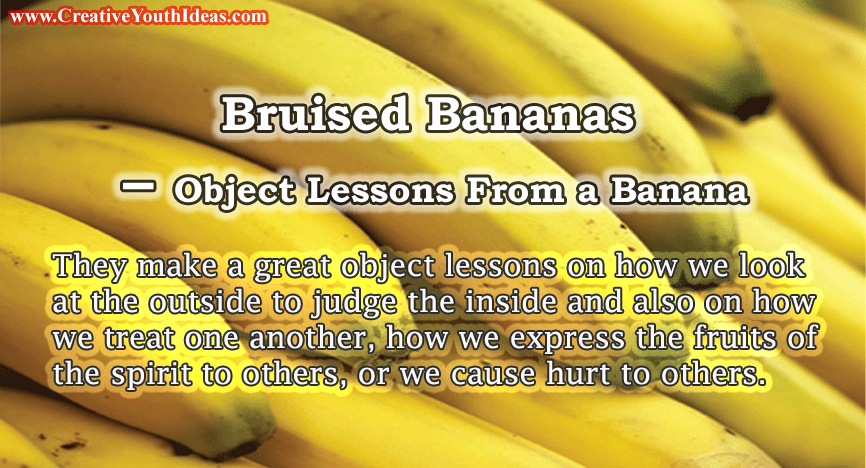
Bananas are enjoyed all around the world. They are full of goodness, but they are easily bruised and can quickly turn to mush. Like many fruits, they can be extremely sweet and a delight. But they can also be easily bruised and turn rotten. They make a great object lessons on how we look at the outside to judge the inside and also on how we treat one another, how we express the fruits of the spirit to others, or we cause hurt to others.

SHARE OBJECT LESSONS FROM BANANAS ON FACEBOOK

Games using Bananas

Warning: Bananas are easily bruised and can quickly become a pile of mush and peel. These games have a tendency to be messy so you will want to play them in an area where it is easy to mop up the mess. You’ll also need a lot of bananas. You can also use plastic or toy bananas for some of the games as this will reduce the number of bananas and can tie in to the later discussion. But real bananas are so much more messy and fun! Green bananas will last a little longer and be a little less messy.

  • A Peeling Bananas – Youth must peel a banana and eat it with hands tied behind their backs.
  • Banana Bites – Give each youth a banana, or choose a representative from each team. The objective is to peel and eat the banana while holding one hand behind his/her back. In other words, the youth must peel the banana with his or her teeth, then eat it. The first to do so and whistle, is the winner.
  • Banana Circle Race – Everyone takes off their shoes and sits with their team in a circle on the floor. Youth must pass a banana around the circle from person to person using only their feet. Each successful pass to a person adds a point but teams lose a point if a hand is used or if the banana is dropped. Once the time is up, the team with the most points wins.
  • Banana Duel – Have everyone pair up and tie their left wrist together with a bandana. Give each a banana to hold in their left hand. When you say “go”, they peel the banana with only their right hand and try to push it in their partner’s face/mouth. You may want to do this blindfolded to add excitement. First to do so wins!
  • Banana Eating Contest – This is the typical peel the banana and eat it contest with a twist. Youth must put one leg of a pair of new nylons over their face. The first person to eat the entire banana through the nylon wins! It can be done but be prepared for a mushy mess!
  • Banana Footrace – Girls must peel a banana and feed it to their team mate using only their feet. You can break the stalk so that the start is easier.
  • Banana Grab(Played like the game of spoons but with bananas) – Have everyone sit around a table and put one banana for each person in the middle of the table. Take one Banana out so there is one less banana than the number of people. Have one person deal four cards to each player. The goal with the cards is to get four of a kind (4 Aces, 4 Kings, etc.) To start the game the dealer will take one card from the remaining deck. They must decide if they want to swap the card out with one of theirs or pass it to the left. If they swap it out, they must pass one of their previous cards to the left, leaving them always with four cards. The person to the left does the same thing with the passed cards and the cards continuously go around the table. When someone has four of a kind they can grab a banana. Once one person has four of a kind everyone else can grab a banana at the same time. Shuffle and deal again, removing one spoon each time and eliminating a new player!
  • Banana Mascots – Each team is given a banana and a bag of random items (felt, foil, beads, etc… BE CREATIVE). They must create a personality and appearance for their banana with the items they get. One volunteer from each group gets up and introduces their banana mascot to the group. It’s better if each group gets different items for variety.
  • Banana Necking – Youth line up single file in teams. Without using hands, they must pass the banana down the line by trapping the banana under the chin.
  • Banana Olympics – Prepare a copy of the tasks for each team and place them in a bag in the middle of the room. The teams should sit at the side of the room. Allocate a bag to each team. Give each team four bananas. One player from each team runs one after the other to their bag and pulls out a piece of paper with a task written on it then runs back to their team. The player reads out the task and performs it. One leader per team should make sure that this is done correctly. The first team to complete the tasks has won. Sample tasks: Drop a banana under your clothes from collar to ankle, Hold two bananas like horns on your head and act like a bull, Tickle a players bare feet with a banana, Throw a banana to the ceiling and catch it again, Sit on a banana and squash it, Walk out of the room with a banana between your knees, Balance a banana on your finger for 5 seconds, Balance a banana on your face for 5 seconds, etc.
  • Banana On a String – Tie strings around several peeled bananas and hang them from the ceiling. Ask for volunteers to race to see who can eat the banana first without touching it with their hands. Increase the difficulty by using unpeeled bananas.
  • Banana Relays – There are a lot of different relay ideas you can do: Carry the banana under your armpit and hop on one foot, Hold the banana between your knees, two teammates toss the banana back and forth down the field and back (designate a minimum number of tosses), Leapfrog formation and first player hops over players while holding banana and then tosses banana to next player in line to do the same. Do them as individual races or combine them all together for each person in line to do something different
  • Banana Rugby – Teams of youth must score goals by throwing a banana into a bucket which is guarded by a goal keeper. Split the group into two equal sized teams who each choose a goal keeper. The keeper will be placed on a stool holding a bucket on the opposite side from his team. Players may not run with the banana. You cannot touch the player in possession of the banana. You can only pass the banana with your hands. A team loses possession of the banana if a member takes more than one step before passing it. Players have a 10 second count to throw or it is an automatic turnover. If a pass is intercepted, is batted to the ground, or goes out of bounds it changes possession. The opposing team starts their turn from where the banana comes to rest. More than one banana in the game means more action! You can also make sure the girls are included by requiring each pass from a guy to be made to a girl and vice versa or only allowing girls to score.
  • Banana Scavenger Hunt – Divide the youth into teams and give them a list of items that can be measured with bananas. Alternatively, you can provide the measurements and they have to find out what was measured in banana lengths. You’ll want to use bananas of the same size, but you can adjust a little by cutting the end of the stem. You can do it at the church, or with permission you may also be able to do something in a public park or shopping mall. You’ll need to get permission for management for shopping malls or places of business, but some will be happy to allow you to do so. (By the way, you can use a tape measure to measure all the items yourself and just divide it by the measurement of your standard banana to get the banana lengths.) Give extra point for the team that eats the mushed banana at the end. You can measure signs, streets, sidewalks, objects, people, places, buildings, etc.
  • Banana Shuffle – Divide your youth group into relay teams with 3 or for persons per team. the first person on each team must run to a designated location and back, holding the banana like a runner’s baton, then pass the banana off to the next team member. Continue until you have a winning team. Variation: Before each runner begins to run they must peel a section of the banana, break off that section and eat it. Enough banana must be left for the last member of the team. You can make it more difficult by turning the race into an obstacle course in which they have to go over, under and around various objects.
  • Banana Slap – Peel a bunch of bananas and hand out the strips of banana peels to everyone. Then you have them partner up and grab a hand of a partner. Play some music. When the music stops, the object is to slap someone in the face with the banana peel before someone slaps you. The winners move on and the losers are eliminated. Last standing wins!
  • Banana Split Bonanza – Create a giant Banana split using a rain gutter. be sure to clean it with soap and water or line it with plastic wrap first.
  • Bobbing for Bananas – Follow the same rules as you would in bobbing for apples, but use bananas instead.
  • Behind the Back Banana Peeling Contest – With hands tied behind their backs using a bandana, team members must race to a pile of unpeeled bananas, select a banana and peel it completely and drop it in a bowl. No hands are allowed. Youth then return to the line where the next member’s hands are tied and sent off to peel a banana. These peeled bananas can later be used in the banana splits-as long as they don’t touch the ground!
  • Doctor Banana – Each team peels and cuts up a banana into equal pieces. Then tell them they must put the banana back together using string, toothpicks, sticky tape, rubber bands, etc. The team that produces the best reconstructed banana wins.
  • Head over Peels – Teams must lie down on their backs in a long line (one persons head at the other persons feet). The person at the front starts with a banana in between their feet and must lift their legs up to pass it on to the next persons feet. The first team to get the banana all the way back to the end of their line wins!
  • Hidden Banana – The youth must stand in a circle with their hands behind their backs. One stands in the middle of the circle. While the person in the middle’s eyes are closed, walk around the outside of the circle and quietly place the banana into someone’s hand. The person in the middle is then allowed to open his or her eyes. The banana is secretly passed from person to person around the circle. The person in the center must study people’s faces and work out who has the banana. If caught with the banana, the person holding it must then replace the person in the center.
  • Instant Banana Splits – A girl from each team makes a banana split in in a teammate’s mouth (guy). Cut a hole in the garbage bag and put it over him so only his head is exposed. The guy lies on the on the floor. Girls stand above him and with hands straight out must drop a slice of banana, a bit of chocolate syrup, some whip cream, chopped nuts, and a cherry into the guys mouth. First guy to eat it and whistle wins. You’ll need some wet towels to clean up.
  • Quickdraw Bananas – Two teams face each other in parallel lines. The people have to put their banana in a pocket. When the signal is given, the people must draw their bananas like guns and instantly peel it and eat it as fast as they can. Whoever has their banana eaten first wins.
  • Steal the Banana – Divide the youth group into equal teams on opposite sides of the room. You can play with more teams so that one team is on each wall of the room. Within each team ask the youth to number off. Place a banana in the middle of the room, halfway between the two teams. Teams must start out touching the wall. Call out numbers and the youth on each team who has that number must run to the banana grab it and bring it back to their team. The first team to collect three banana’s wins.
  • Tallest Tower – Each team of youth sits in a circle with 6-10 bananas. Within a given time limit the team that builds the tallest tower using the bananas wins. You can make it more challenging by requiring that only one banana is allowed to touch the table.
  • Whole Bananas – Divide into teams and then members of each team pair up with a partner on the same team. Provide one banana for each pair who will peel it and then place opposite ends of the banana in each persons mouth. Then they run together around a chair placed about 10 feet away and back to their team. Then the next two people peel their banana and the relay continues. Each pair scores 3 points for the team for completing their run without breaking their banana and 1 point for making the run with a broken banana. The first team to have all its pairs complete their runs gets 5 extra points. Highest score wins!

TAKE IT TO THE NEXT LEVEL

For added spiritual application you can prepare one or more of the following props. These can each represent a possible spiritual condition as indicated in the parenthesis. Keep it simple for younger age groups, or expand it for those who are more mature.

  1. Place a banana in the fridge for a couple days, the skin will turn black, but it will still be fine inside. (Outside it looks a mess, but inside it is still wholesome.)
  2. Just before your meeting, carefully squeeze and bruise a banana so that the inside is bruised and mushy, but the outside skin is still whole and unbroken. (Outside looks fine but inside it has been bruised)
  3. Add a plastic or fake banana (It’s fake)
  4. Let one banana rot (Rotton both outside and inside)
  5. Green Banana (Fruit is not fully expressed yet… it is still growing)
  6. Ripe banana that is perfect for eating (Sweet and enjoyable)
  7. Banana that which was used in the games and is now quite a mess. (Abused, injured, bruised by others)
  8. Label from some other fruit on a banana (Labels, name calling, not true)
  9. Before the lesson, get a banana & a sewing needle. You insert the sewing needle into several spots through the banana skin and sort of “swish” it back & forth, so that you cut the banana into pieces inside its skin. (Looks fine on the outside, but is all cut up on the inside.)

MAKE IT SPIRITUAL

  • What was the key ingredient of the games?
  • What is a banana?
  • What are some characteristics of a banana?
  • In what ways could what happened to the bananas, be similar to what can happen to people?
  • Have you ever been hurt or injured by someone? Even if it was just a game, can people still be bruised and hurt?
  • What does this tell us about how we treat people?
  • Scripture says that Christians are known by their fruit. (Matthew 7:20) How do we evaluate whether fruit is good or bad?
  • How can these Banana’s (refer to props) represent spirit conditions of a person?

MAKE IT PRACTICAL

  • What are the first things that come to mind when you consider the question: “How is your spiritual life going these days?”
  • What are some of the things that people use to determine the quality of a person’s spiritual life?
  • How do you know if a person is a Christian or not?
  • What are some of the things that people use to evaluate if a person is a Christian? Of the things that you have listed, which are actions, words, thoughts, values?
  • Are the things in the list mostly internal or external things?
  • What are some of the fruits of a Christian’s life? (see Galatians 5:22-23)
  • Are these internal or external, or both? Explain.
  • Which traits of the fruit of the Spirit are easiest for you?
  • Which ones are the biggest areas of growth for you?
  • The list in Galatians was not meant to be the total list as other qualities are also mentioned in scripture like holiness, humility, compassion, generosity, contentment, thankfulness, mercy, grace, sincerity, and perseverance. Which trait(s) on this “expanded” list of the fruit of the Spirit come easiest and hardest for you?

MAKE IT PERSONAL

  • Take time to discuss ways youth have shown the fruits of the spirit or have experienced them. Also, discuss experiences that have bruised us and hurt us. How did each of these experiences make us feel? What can we learn from them? How does it affect you or others?
  • Which of fruits are lacking in your life? why?
  • What do you need to do to grow and become more fruitful?
  • What can you learn from this lesson in how you personally treat others?

SPIRITUAL LESSONS FROM BANANAS

Be Careful How We Treat Others
Bananas are really fragile fruits that need careful handling and preparation. You have to handle bananas gently so you don’t bruise them. The same holds true for the way we treat others. Our words and actions towards others can leave bruises upon their hearts just like bruises on a banana that has not been handled with care. Sometimes, a person who has been treated unkindly for a while can become angry and bitter inside. He starts to decay from the inside. But even if the fruit becomes rotton, the seeds can be planted in good soil and new and wonderful can grow out of it. God has the power to come into our lives, to give us new life, and the opportunity to abide in him and produce good fruit.

Don’t Judge by the External
Unfortunately there are also those who try to fake the fruit of the spirit in their lives. Fruit is a natural product of drawing from the source (John 15) You don’t force fruit. It is the outflow of abiding in Christ. Some people pretend that they are loving, kind people, but they are really angry bitter people on the inside. Some people try to pretend that they have joy because of material things, but really they are unhappy miserable people. You can’t always tell the quality of fruit by it’s outside. What you look like on the outside is not what is important to God. What your heart and life look like on the inside is what is important to God. How do we know if a banana is good? First we look at what we can see. Then we open it up and look at the inside. How do we know if a person is a Christian? We look at their lives that we can see, but that doesn’t always tell us accurately. As Christians we should not only have good outsides, but we should have good insides. People we are around look at what they can see so we need to be sure we are acting the way Jesus wants us to. God looks at the inside so we need to make sure that we are acting the way Jesus wants us to!

SCRIPTURE VERSES

  • Psalms 34:8 – “O taste and see that the Lord is good! How blessed is the man who takes refuge in Him”
  • 1 Samuel 16:7 – “But the LORD said to Samuel, “Do not consider his appearance or his height, for I have rejected him. The LORD does not look at the things people look at. People look at the outward appearance, but the LORD looks at the heart.”
  • Galatians 5:22-23 – “But the fruit of the Spirit is love, joy, peace, forbearance, kindness, goodness, faithfulness, 23 gentleness and self-control. Against such things there is no law.”
  • John 15

MORE IDEAS? See “Creative Object Lessons”

200 page e-book that explains everything you need to know when planning your very own object lessons. It contains 90 fully developed object lesson ideas and another 200 object lesson starter ideas based on Biblical idioms and Names / Descriptions of God.
Learn More…

Teddy Bear Faith

Teddy Bear Faith

When you were younger did you have a teddy bear or another cherished possession? Did you hold it, talk to it, hug it close? Did it comfort you, give you courage? If you couldn’t find it, did you turn everything upside down looking for it? Teddy Bears remind us of a childlike faith. They remind us of the sense of security and comfort we gained simply by their presence. God loves us more than any beloved Child’s possession. And His constant companionship reminds us of the comfort, the security, and love that can only be found in Him.

PLEASE SHARE THIS IDEA ON FACEBOOK – CLICK HERE

The Story of the Teddy Bear

In 1902, Theodore Roosevelt, the President of the United States, went hunting in the woods but didn’t kill anything. Before he left, one of his aides found a lost bear cub and offered it to him. But Roosevelt refused to shoot the bear, saying it would be unsporting. The next day a cartoon depicting the president having mercy on the cub appeared in newspapers across the US. A New York candy shop owner, Morris Mitchtom, saw the cartoon, asked his wife to make a toy bear to put in the shop window alongside the cartoon, and gave him a name: “Teddy’s Bear”. Mrs Mitchtom’s bear proved so popular that within a year she and her husband closed the candy shop and founded the Ideal Novelty and Toy Company, now one of the biggest in the world.

Games using Teddy Bears and Stuffed Animals

Note: Get teddy bears and stuffed animals cheaply at the nearest Goodwill or Salvation Army store. You can always donate them to a children’s charity or back to where you got them after your event. Giant stuffed animals and bears increase the level of fun!

  • Back to Back Bear Race – Split the youth up into partners however many as necessary. The players have to put a teddy bear between both of their backs and walk to the finish line and back to the team. First team to finish wins. You can make it more difficult by making it an obstacle course rather than a simple race. If the bear is dropped they must return to their team and begin again.
  • Hot Teddy Bear Attack – This is a variation on the old “Hot Potato” game. Give each youth one of the animals and have them stand in a circle. One or more Teddy Bears are the hot potato. Use more than one if you have a large group. While the music is playing, the youth must pass the stuffed animals in one direction around the circle as fast as they can. When the music stops, the people who are left holding the Teddy Bears are out. All of the rest of the people at that time get to attack the ones who are out with their animals by hurling them at high velocities. (Make sure the animals have no hard eyes etc so that no one get’s hurt) Once everyone who is still in picks up an animals, start over again. Make sure you include the Teddy Bears back in the game for each round.
  • Stuffed Animal Charades – Place a variety of stuffed animals in a box or king-sized pillow case. As each player takes their turn, in another room or away from all the other players, he or she blindly reaches into the box or pillow case and takes out a stuffed animal. The player acts out the animal while the other players try to guess what animal is being portrayed.
  • Stuffed Animal Personalities – Place a large collection of stuffed animals in the center of the youth group. Begin the conversation by asking your participants to share with you personality traits of each animal. During the discussion ask the participants to be thinking about which animal reflects some traits of their own personalities.
  • Teddy Bear Dodge Ball – Play a traditional game of dodge ball, but with Teddy Bears.
  • Teddy Bear Flag Football – In flag football, instead of tackling, you pull the flag from a person’s pocket. A flag can be a piece of cloth or a bandana. If your youth don’t have pockets, you can also attach a strip of cloth to a clothespin and it can easily be inned to a shirt tail. You’ll need a room large enough for running and passing. Place goal posts made from crepe paper on opposite walls. Field goals are awarded if the bear hits the wall inside the goal posts. You can use masking tape or crepe paper for goal line markers as well. You may want to include a girls-only quarter, follow boys-only quarter.
  • Teddy Bear Hat Trick – Position teddy bears or stuffed animals of various sizes and point values on the other side of a starting line. Teams toss a hat onto the targets. Team with the most points wins.
  • Teddy Bear Pass – Played just like Hot Potato, youth must pass a teddy bear around the circle when the music starts. When it stops whoever is holding it is eliminated.
  • Teddy Bear Pinata – Get a Pinata in the shape of a teddy bear and tie it to a rope that is hung between two trees. Youth are blindfolded, given a plastic baseball bat, and get three swings to break the pinata.
  • Teddy Bear Rescue – All youth stand around a blanket holding an edge. When you toss individual bears high into the air, the youth must try to catch the bear in the blanket.
  • Teddy Bear Targets – Position baskets or rings of various sizes and point values on the other side of a starting line. Teams toss stuffed animals or teddy bears into the targets for points. Team with the most points wins.
  • Teddy Bear Toss – Divide the youth into pairs. Each pair is a team. The winning team is the team who can throw and catch their bear over the greatest distance. Giant Bears make the game much more fun! Have participants start 10 metres apart. After each throw each member will move further apart. The team members alternate their throwing and catching roles after each throw. A bear catcher may not move from his/her starting position until the bear to be caught is in the air en route to that catcher. The pair that manages a successful toss of the greatest distance is judged to be the winner.
  • Teddy Bear Volleyball – Divide into teams of two, each person holding a towel at the corners. Teams stand on opposite sides of a volleyball net or some kind of divider. Each team must use the towel to toss a bear back and forth with another team. Continue playing until the bear is missed and a point is scored. You can play according to traditional volleyball rules on serving and scoring.
  • That’s My Teddy – Ask each youth to bring a teddy bear or stuffed animal to the party. (At the end you can even donate some of them to a needy children) At one point, put all of the stuffed animals into a pile and bring in each youth one-by-one and blindfolded to identify his/her stuffed animal from the pile, using only the way it feels as a guide.
  • Ultimate Bear – Play like this like Ultimate Frisbee but replace the frisbee with a bear. Form two teams. Players must move the bear by tossing it from one player to another until the bear can be passed and caught across the goal line. You cannot run with the bear and must plant one foot and pivot when you are holding it. If the teddy bear is intercepted or falls to the ground, the other team takes possession.
  • Warp Speed Teddy – Arrange participants in a circle, not too close, not too far from one another. Toss a teddy bear to someone else in the circle. If you receive it, toss it to someone else in the circle not immediately on either side of you. That person will toss it to another person who has not yet received it and again not immediately on either side of him or her. Once you have received the bear and passed it on to someone else, put your hands down to your side to indicate you have already received it. Throwing continues until the last person tosses the ball back to the first person. They must remember who they tossed to because they will try to recreate the pattern in the next run, only faster.

TAKE IT TO THE NEXT LEVEL

MAKE IT SPIRITUAL – Lessons from Teddy Bears

1. Love

God Loves you more than a Teddy Bear – When you were younger did you have a teddy bear or another cherished possession? Did you hold it, talk to it, hug it close? Did it comfort you, give you courage? If you couldn’t find it, did you turn everything upside down looking for it? You loved it in precious, innocent way that a five-year-old loves things? You always wanted it with you. God loves you far more than you ever loved your teddy bear. God has so much more love for us than we could ever imagine. In fact, he loved us so much he gave himself for us, to pay our debt of sin, by dying in our place that we might live with him in heaven. As we have grown out love has grown as well. But the truth is we can never love more than God.

MAKE IT PRACTICAL

  • In what ways do we underestimate God’s love for us? Why?
  • In what ways does God show his love for us?
  • How should we respond to God’s love for us?
  • Explain, “We love God, because he first loved us” 1 John 4:19
  • What lessons about love can we learn from 1 John 4:7-21?

2. Value

The Bear’s value wasn’t based on its cost. In fact, you probably had no idea of the cost of the bear. It may have cost very little, but in your eyes it had great value. It’s value was not based upon what it was made of, how nice it looked, or how what it cost to make it. It’s value was based on how much you as a child cherished it and loved it, how dear it was to you. You loved it because it was yours. In fact, in time the bear probably lost a lot of fur, became tattered, dirty, and maybe even started to fall apart. But you loved it all the same. The same is true of you. God loves you and your worth is found in how dear you are to him. He made you, he bought you, and he loves you. Sometimes your life may become a little tattered, dirty, and even seem to be falling apart. But God loves you even more than you loved your teddy bear. To the world you may seem insignificant, worthless, falling apart, but to God you are everything, you are cherished, you are loved, simply because you are his.

MAKE IT PRACTICAL

  • How do you decide if something is valuable?
  • What decides the value of something?
  • How valuable are you to God? What was he willing to pay for you?
  • How does knowing that God CHOSE you make you feel?
  • How can realising God’s value for you and the price he paid for you motivate your life?

3. Comfort and Security

As children, a Teddy Bear gives us comfort and security. It is a constant companion. We cling to it in times of fear. We cherish it, and give it a special place in our lives. But as we grow older, our simple faith matures and the comfort and security is found in parents. But soon we also must move beyond that and we realise we can only find true comfort and security in God. True security and comfort can only come from our relationship with Him.

MAKE IT PRACTICAL

  • When are times that Jesus can be a comfort to us?
  • How can we be a comfort to others?
  • What comforts you and gives you security?
  • Why are we safe in God’s hands?
  • How can knowing that God is always there for us help us to live a better life?

MAKE IT PERSONAL

  • How can you rest in God’s Love? His Comfort? His security?
  • Knowing that you are precious and valuable to God, what does this knowledge motivate you to do this week?

————————————————

SCRIPTURE VERSES

————————————————

  • 2 Corinthians 1:3-4 – “Praise be to the God and Father of our Lord Jesus Christ, the Father of compassion and the God of all comfort, who comforts us in all our troubles, so that we can comfort those in any trouble with the comfort we ourselves receive from God.”
  • Psalm 62:1-2 – “My soul finds rest in God alone; my salvation comes from him. He alone is my rock and my salvation; he is my fortress, I will never be shaken.”
  • Psalm 112:8 – “His heart is secure, he will have no fear.”
  • Psalm 16:5 – “LORD, you have assigned me my portion and my cup; You have made my lot secure.”
  • Isaiah 41:10 – “So do not fear, for I am with you; do not be dismayed, for I am your God. I will strengthen you and help you; I will uphold you with my righteous right hand.”
  • Romans 8:15-16 – “For you did not receive a spirit that makes you a slave again to fear, but you received the Spirit of sonship. And by Him we cry, “Abba, Father.” The Spirit Himself testifies with our spirit that we are God’s children.”
  • Ephesians 1:4-8 – “For He chose us in Him before the creation of the world to be holy and blameless in His sight. In love He predestined us to be adopted as His sons through Jesus Christ, in accordance with His pleasure and will– to the praise of His glorious grace, which He has freely given us in the One He loves. In Him we have redemption through His blood, the forgiveness of sins, in accordance with the riches of God’s grace that He lavished on us with all wisdom and understanding.”
  • Hebrews 13:5 – “Never will I leave you; never will I forsake you.”
  • See also PSALM 91:1-16

PLEASE SHARE THIS IDEA ON FACEBOOK – CLICK HERE

MORE IDEAS? See “Creative Object Lessons”

200 page e-book that explains everything you need to know when planning your very own object lessons. It contains 90 fully developed object lesson ideas and another 200 object lesson starter ideas based on Biblical idioms and Names / Descriptions of God.

Learn More…

Lego Instructions for the Christian Life

LegoInstructions

LEGOs are one of those toys that are universally loved around the world by all ages. They are simple building blocks in a variety of shapes and colors, but with a little creativity and imagination they can be put together in unlimited combinations to create masterpieces. They are a great metaphor for each of us in the body of Christ. And if we follow God’s instruction we can be used to create and do incredible things.

PLEASE SHARE THIS IDEA ON FACEBOOK – CLICK HERE

Games using LEGOs

  • Blind Builder – A player is blindfolded and must construct the item solely from verbal directions from the team. First to team to complete it wins.
  • Blind LEGO Construction – Blindfold each team and ask them to build a Lego sculpture using a pile of Lego pieces in front of them. Give awards for the most like a real object, funniest, tallest, longest, most creative, etc
  • Fast As You Can – In this game you call out a simple object that can be created from LEGO’s. Each team has three minutes to make one as fast as they can. At the end of the three minutes have a judge decide who sculpture most resembles the object. Play a couple of rounds so there are more chances for winners.
  • Guess How Many LEGO Bricks – Guess how many bricks in a lego jar? The winner could go home with the jar of LEGOS.
  • I Spy The LEGO Guy – Get several LEGO guys and hide them in various places around the room. The youth or team to locate the most wins.
  • LEGO Car Race – Divide the youth group into teams and provide each team with a duplicate pile of plastic LEGO building blocks and four LEGO wheels. Within a given time limit, the team must build a car, create a nickname for the car, a racing team name and choose a mascot. Allow each team to line up their racers on a starting line and race them down a makeshift ramp. Your ramp can be a long table propped up on one end, or even a wide board or two. Have challenges or race all at one go.
  • LEGO Chopsticks – Place two bowls in front of each team: one filled with LEGO blocks, and the other empty. Give the youth one minute to move as many LEGO blocks as they can from the full bowl to the empty bowl using only the chopsticks
  • LEGO Identity – Give each group an assortment of peices with the instructions to build something that represents them as a group.
  • LEGO Me – Have youth select a specific lego piece that represent them as an individual and explain it’s significance. Then have them use all the pieces to build one object.
  • LEGO Memory – Before the game, build a structure with Legos (the more complex the structure, the more difficult the activity). Then put the youth in small groups, each group with a bag of Legos (each bag contains the same size, color, and quantity of Legos and has identical stock as that of the structure you built). The group has to exactly replicate the structure you already built. But, the structure to replicate is located outside the room or behind a screen, only one person from each group may look at the structure at a time. They cannot draw or take a picture of the structure to communicate it – they have to use their memory. Each team can look at the structure as many times as they want, but only one person can look at it at a time. The first to replicate the structure – exactly with the same size and color Legos wins.
  • LEGO on a string – Have the youth form a circle, facing inward, with one youth in the middle. String a LEGO piece with a hole in it on a long piece of string and then tie the ends of the string together. Place the string inside the circle and have each youth hold it with both hands . The idea is to pass the LEGO around the circle from hand to hand, unnoticed by the youth in the middle . He tries to guess where it is by pointing to the hand he thinks is holding the LEGO. If he is correct, the LEGO holder goes to the middle and the guesser takes his place in the circle . The youth in the middle must keep guessing until he locates the LEGO.
  • LEGO Scavenger Hunt – Hide an assortment of LEGO bricks and the youth search for them. You can award point values to the different brick colors and have them compete for a high score.
  • LEGO snapshots – Take pictures of simple LEGO structures, and have the youth try to duplicate it from the picture only. You might need a photo from more than one angle to get all the pieces.
  • LEGO Tongue Tower – To win this game, the a youth must first put a tongue depressor (or plastic spoon) in their mouth then build a tower of five loose Legos on the tongue depressor (still in their mouth) and then keep the LEGOS balanced for ten seconds.
  • Lose the LEGOS – Tape an empty tissue box the rear of each player with the opening facing away from the player. You can do this with team representatives or individually if you have enough tissue boxes. You can also have timed trials to determine the fastest. Once the tissue box is taped on, the time will start and the player must shake their rear to be the quickest to get all of the LEGOS to come out of the tissue box.
  • Quickest LEGO Builders – Get a brand new small box of legos, with a picture on the front of the completed set, for each team. Pass it out to the teams and on go they must build the set. Quickest to do so wins. You can also find blueprints for a variety of lego projects at www.letsbuilditagain.com
  • Strongest LEGO Bridge – Give each team of youth a set amount of time to build the strongest bridge. Then line up and test them. You can use ziplock bags filled with rice (250grams), soft wrist weights or anything which will not damage your floor when in falls. Amazingly they have been known to hold 5kg (11.02 pounds) so make sure you have enough weight to test them.
  • Tallest LEGO Tower – See which team can build the tallest tower in a predetermined time limit without the tower falling over.
  • What am I? – Divide the youth into teams and supply each team a pile of Lego parts that include pieces to make cars, trucks and people. Have everyone write down a name of a person, place or thing on a small slip of paper (tell them not to show anyone else). Ask each youth to fold his or her slip of paper and place it in a hat. Mix the slips of paper and ask one member from each team to randomly select one slip of paper. Tell the team member not to show the paper to his or her teammates. Set a kitchen timer for 10 minutes and tell the team member who chose the slip of paper to build whatever was on that slip of paper. It is up to his or her teammates to guess what he or she is building based on his or her creation. No talking or gestures are allowed. The first team to correctly guess the right answer wins that round.

TAKE IT TO THE NEXT LEVEL

Debrief

  • What do we need that will help us turn a pile of pieces into a specific shape?
  • Do you have to build exactly what is on the LEGO box or in the instructions?
  • Can we use the pieces to build other good things as well?
  • (If it has step by step instruction) Do you have to follow the instructions?
  • What is the advantage of instructions?
  • How does a photo, an example or instructions help?
  • What could have happened if we didn’t follow the manual?
  • How did the groups go about assembling their Lego project? How did each person participate?
  • What was frustrating about this activity?
  • Why was it difficult/easy to communicate instructions?
  • What are other situations that happen in your life where you have to rely on others to communicate information or instructions to you?
  • How do you make sure that you understand them completely? What can you do as the person with the information to get your message across to others?
  • How do you know where a brick belongs and how it fits into the overall plan?
  • Is it sometimes possible for more that one brick to fit in the same?

MAKE IT SPIRITUAL

  • What spiritual lessons can we learn from LEGOS?
  • What could happen if you don’t follow the instructions?
  • How is this like the choices we have in life?
  • Were you created with a purpose?
  • What other projects or things have you done that require an instruction manual?
  • Are there instructions for us to follow in life? As a Christian?
  • What are some of the world’s instructions? Those from the Bible?
  • How is a lego set like the body of Christ?
  • How is the Bible like an instruction manual?
  • How is Christ a model for us to follow? (1 Corinthians 11:1)

MAKE IT PRACTICAL

A LEGO manual shows how each piece fits together to form the completed shape and the order or sequence.

How is a lego set like the body of Christ? the youth group?

  1. made up of many parts.
  2. Christ is the cornerstone
  3. The parts fit together to make a whole
  4. if one part is missing, the whole suffers – to be complete they need each other
  5. no piece, is more important that the others.
  6. some relationships are closer than others
  7. together they form a picture / object
  8. they didn’t have the instructions or a picture on a box so it was sometimes difficult to know what they were forming
  9. different people acted as leaders to help them form the picture
  10. The pieces support each other
  11. there are different connections – shapes – that connect each
  12. each piece is different / unique
  13. Each piece is identified by where it fits into the whole
  14. Some pieces are easily identified but not more important

MAKE IT PERSONAL

  • How can we learn where we belong in the church and the role we each should fill?
  • After this activity, ask each youth to take back their LEGO piece as a reminder of the lessons.

SCRIPTURE

  • 1 Corinthians 3:11-15 – “For no one can lay any foundation other than the one already laid, which is Jesus Christ. If anyone builds on this foundation using gold, silver, costly stones, wood, hay or straw, their work will be shown for what it is, because the Day will bring it to light. It will be revealed with fire, and the fire will test the quality of each person’s work. If what has been built survives, the builder will receive a reward. If it is burned up, the builder will suffer loss but yet will be saved—even though only as one escaping through the flames.”
  • 1 Peter 2:4 – “As you come to him, the living Stone—rejected by humans but chosen by God and precious to him— 5you also, like living stones, are being built into a spiritual housea to be a holy priesthood, offering spiritual sacrifices acceptable to God through Jesus Christ.”
  • Ephesians 2:19-22 “Now, therefore, you are no longer strangers and foreigners, but fellow citizens with the saints and members of the household of God, having been built on the foundation of the apostles and prophets, Jesus Christ himself being the chief cornerstone, in whom the whole building, being joined together, grows into a holy temple in the Lord, in whom you also are being built together for a dwelling place of God in the Spirit.”

PLEASE SHARE THIS IDEA ON FACEBOOK – CLICK HERE

MORE IDEAS? See “Creative Object Lessons”

200 page e-book that explains everything you need to know when planning your very own object lessons. It contains 90 fully developed object lesson ideas and another 200 object lesson starter ideas based on Biblical idioms and Names / Descriptions of God.
Learn More…

Creative Youth ideas: 1700+ Resources for youth leaders, pastors, ministers to help plan camps, retreats, and meetings using games, illustrations, Children's Worship, Bible Studies, object lessons, sermons, creative ideas,creative activities